
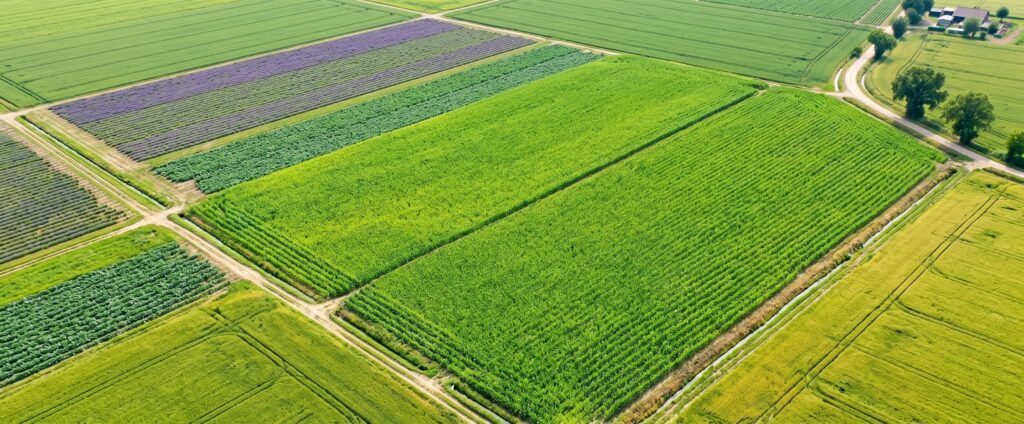
From the 1980 Supreme Court patent ruling to atmospheric chemical drift, how four decades of corporate agriculture captured our food supply, accelerated climate damage, and broke our biological baseline.
The Illusion in Aisle 5
Walk into any American supermarket, and you are greeted by an illusion of infinite choice.
Bright packaging fills thirty aisles, showcasing hundreds of distinct brands of sandwich bread, breakfast cereals, snacks, condiments, and frozen meals. Look past the marketing graphics to the ingredient deck, and that variety disappears.
Nearly every box, bag, and bottle is constructed from the exact same industrial base: Number 2 Yellow Dent field corn and commodity soybeans. They are broken down into high-fructose corn syrup, chemically extracted seed oils, bleached starches, and artificial emulsifiers.
American consumers did not demand a diet of engineered starches. This food environment was built through a four-decade convergence of Supreme Court patent decisions, federal grain subsidies, and agrochemical dominance that transformed family farms into corporate supply lines and the human gut into an afterthought.
Behind the illusion of choice sits a tightly consolidated cartel:
| Industry Chokepoint | Market Control | Key Conglomerates |
|---|---|---|
| Global Grain Trade | 70% to 90% | The “ABCD” giants: ADM, Bunge, Cargill, Louis Dreyfus |
| U.S. Corn & Soy Seeds | Over 70% | Bayer (Monsanto) and Corteva (Dow-DuPont) |
| Pesticides & Ag Chemicals | Over 70% | Bayer, Corteva, Syngenta (ChemChina), BASF |
| U.S. Beef Processing | 85% | Tyson Foods, JBS, Cargill, National Beef |
| Center-Aisle Grocery Brands | Over 80% | 10 conglomerates (Nestlé, PepsiCo, General Mills, Mars, Unilever, Kraft Heinz, Coca-Cola) |
When four or fewer firms control more than half of an industry, true market competition ceases to exist. What looks like a free market is an industrial bottleneck.
Capturing the Seed (1980–1996)
For ten thousand years, agriculture rested on a simple, self-sustaining rule:
Farmers planted a crop, harvested the grain, and saved the best seeds to replant the following spring.
That cycle ended in 1980 with the landmark Supreme Court ruling Diamond v. Chakrabarty. In a 5-4 decision, the court ruled that human-altered living organisms could be patented under federal law. Life became private intellectual property.
During the same period, agrochemical giant Monsanto faced a major financial hurdle. The original patent on its blockbuster weedkiller, glyphosate (Roundup), was approaching its expiration. Once the patent lapsed, low-cost generic manufacturers would flood the market.
The corporate strategy shifted from selling chemicals to engineering the seeds themselves.
Biotech researchers spliced bacterial DNA into crops, creating Roundup Ready soybeans and corn that could survive direct drenching with glyphosate while every surrounding weed died.
Monsanto patented the modified genetics, bundled the seeds with its proprietary herbicide, and required growers to sign strict Technology Stewardship Agreements.
Saving seeds became a federal intellectual property violation. The company deployed private investigators and field auditors across the Midwest, filing hundreds of lawsuits against farmers who attempted to clean and save their own grain.
For an in-depth breakdown of the corporate paper trail and legal enforcement, watch Monsanto: The Company that Owns the World’s Food Supply.
The Federal Engine and the Fuel Mandate (1996–2005)
Corporate seed patents required government policy to reach nationwide scale.
In 1996, the Clinton administration signed the Federal Agriculture Improvement and Reform (FAIR) Act, known as the “Freedom to Farm” bill. The legislation dismantled New Deal-era supply controls that paid farmers to leave land fallow to prevent massive crop surpluses.
Farmers were incentivized to plant fence-row to fence-row for global export markets, while the administration maintained that GMOs were “substantially equivalent” to conventional crops and opposed mandatory federal labeling.
Surpluses of commodity corn and soy surged, causing grain prices to drop. Agribusiness processed these cheap excess bushels into high-fructose corn syrup and shelf-stable fillers, flooding processed food manufacturing.
A decade later, the Renewable Fuel Standard (RFS) under the Bush administration mandated blending billions of gallons of corn-based ethanol into the nation’s gasoline supply. Millions of acres of native grasslands, wetlands, and conservation reserves were plowed under to plant continuous, single-crop cornfields.
Research published in the Proceedings of the National Academy of Sciences (PNAS) showed that this land-use conversion released massive reserves of stored underground soil carbon, making corn ethanol at least 24% more carbon-intensive than straight gasoline.
The ecological degradation caused by continuous monocultures mirrors other human-driven crises. Much like the overlooked environmental legacy of war, intensive chemical farming creates long-term damage that compromises vital ecosystems for generations.
The Metabolic Trap and the Compliant Mind
The human body was not designed to run on refined commodity derivatives.
Diets dominated by high-fructose corn syrup, refined seed oils, and low-fiber starches create a relentless blood sugar cycle. Rapid glucose spikes trigger aggressive insulin surges, followed by steep energy crashes that leave individuals with persistent physical exhaustion and brain fog.
At the digestive level, synthetic emulsifiers and the absence of dietary fiber degrade the mucosal lining of the gut, killing beneficial microbial colonies.
This gut permeability allows inflammatory endotoxins into the bloodstream, crossing the blood-brain barrier and causing neuroinflammation. When systemic inflammation dampens dopamine and serotonin signaling, executive function, long-term drive, and energy reserves drop sharply.
Rather than fixing the toxic food baseline, the system engineered the ultimate commercial closing loop by monetizing the symptom.
When forty years of ultra-processed foods broke the nation’s metabolic health, the pharmaceutical industry arrived with the “miracle” solution: blockbuster GLP-1 receptor agonists like Ozempic, Wegovy, and Mounjaro.
These injectable drugs do not restore cellular health, rebuild the gut microbiome, or clean up the food supply.
They chemically force the stomach to empty slower and artificially suppress the appetite signals that Big Food spent billions engineering to be insatiable.
It is a lifelong, thousand-dollar-a-month subscription model:
- Big Ag grows the cheap commodity starch.
- Big Food manufactures the hyper-palatable, addictive grocery staples.
- Big Pharma sells the lifelong synthetic treatment to counteract the diet.
The consumer pays at every stop, first at the grocery checkout, then at the pharmacy counter, while the root of the crisis remains entirely untouched.
The Atmospheric Cloud, Climate Burden, and the Developing Brain
Industrial agriculture does not stay confined within farm fences.
Sustaining millions of monoculture acres requires billions of pounds of synthetic nitrogen fertilizer manufactured from fossil natural gas.
Once applied to the soil, it converts into nitrous oxide (N₂O) a greenhouse gas, nearly 300 times more potent at trapping heat than carbon dioxide that persists in the atmosphere for over a century.
Meanwhile, chemical weedkillers sprayed across open fields volatilize into the air, attach to fine particulate dust, and travel on atmospheric wind currents.
Testing by the U.S. Geological Survey (USGS) across major agricultural basins has confirmed detectable concentrations of glyphosate and its chemical breakdown products in ambient air and rainfall samples.
The highest physiological burden lands on young, developing brains:
- Children breathe more air, drink more water, and consume more calories per pound of body weight than adults.
- Their enzymatic detox pathways and blood-brain barriers are still actively forming.
- When airborne chemical drift combines with a low-nutrient, ultra-processed diet, the total environmental and metabolic load stresses early neurodevelopmental wiring.
The industrial farm model is no longer just a grocery store issue, it circulates in our air basins, our fuel tanks, and our regional water tables.
Reclaiming Autonomy and Civic Accountability
Bypassing this centralized industrial pipeline requires action on two fronts:
Practical autonomy at home and uncompromising accountability at the ballot box.
1. Garden Seeds Are Not Patented
Corporate patents control industrial crops like field corn, soy, canola, and cotton. Standard backyard vegetables like tomatoes, peppers, lettuces, cucumbers, and squashes remain non-GMO.
True seed independence still requires choosing the right varieties. Many commercial seed packets contain F1 hybrids. Seeds saved from hybrid plants do not grow true-to-type next season, leading to weak or unpredictable crops.
Buy open-pollinated and heirloom seeds from independent seed houses or local public seed libraries. These varieties pass stable genetics to their offspring. You can harvest, dry, store, and replant your harvest year after year for free.
2. High-Yield Container Growing
You do not need acreage to produce clean food:
- A single cherry tomato plant in a standard 5-gallon bucket with drainage holes yields hundreds of sun-ripened tomatoes across a single season.
- Patio containers of loose-leaf greens (spinach, arugula, butterhead lettuce) provide continuous harvests within 30 days when cut from the outer leaves.
- Culinary herbs (basil, rosemary, thyme) grow easily on a sunny windowsill, eliminating the highest per-ounce markups at the supermarket.
3. Bypassing the Meatpackers
Instead of purchasing factory-farmed meats packaged in plastic, connect directly with local pasture operations through regional farm directories. Buying directly from local growers secures pasture-raised beef, chicken, and eggs while keeping money in local agricultural economies.
4. Cutting the Industrial “Big Three”
Eliminating high-fructose corn syrup, refined seed oils (soy, corn, canola), and artificial emulsifiers instantly removes roughly 80% of the industrial monoculture from your kitchen.
5. Following the Money to the Ballot Box
The industrial monoculture was built through legislation, and dismantling it requires targeted civic accountability. Agrochemical conglomerates, food monopolies, and biotech firms pour millions into political action committees (PACs), Super PACs, and lobbying firms to keep politicians on key agriculture, energy, and commerce committees compliant.
To understand corporate capture in our food system, we have to look past the political theater. Real systemic change requires evaluating political events and measuring true institutional accountability rather than accepting surface-level promises.
- Check Campaign Donors: Before casting your vote in local, state, or federal elections, look up candidate donor filings on nonpartisan tracking databases like OpenSecrets.org and the Federal Election Commission (FEC).
- Spot Ag & Chemical PAC Influence: Identify which candidates accept substantial funding from seed monopolies, pesticide lobbies, and ultra-processed food conglomerates.
- Support Unbought Candidates: Prioritize representatives who reject corporate PAC contributions, fight for antitrust enforcement in agriculture, advocate for soil restoration, and protect consumer transparency.
Changing what you put on your plate protects your household today.
Voting for leaders free from corporate capture protects the environment, our children’s future, and the food supply for generations to come.
Now it’s your turn: Have you noticed changes in the quality of your grocery staples, or have you started growing your own food at home to step outside the industrial chain? Drop your thoughts and experiences in the comments below.