
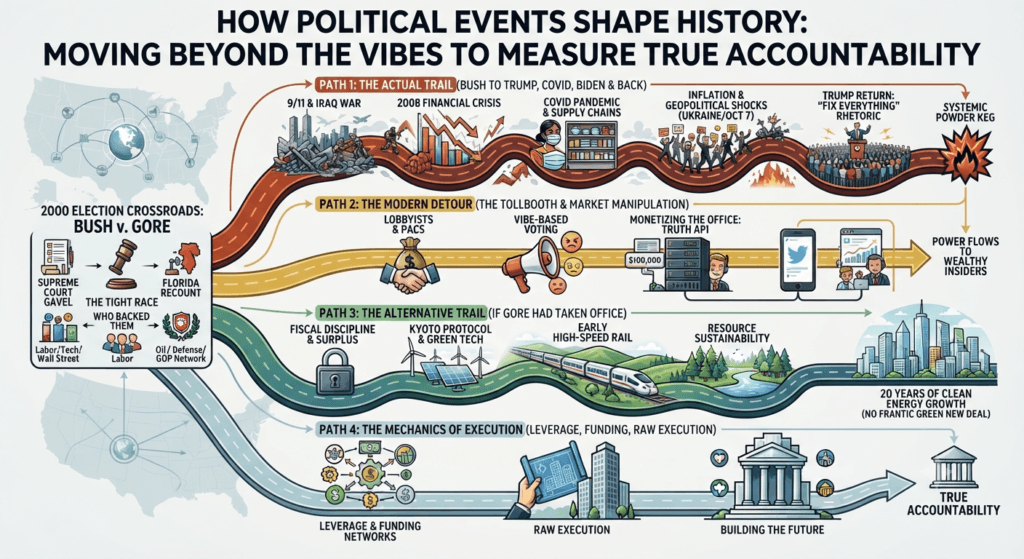
The Crossroads (2000 Election Turning Point, Donors, and a Divided Nation)
The 2000 presidential election became a historic showdown, as America found itself split right down the middle. The race came to a head with Florida, where every vote truly mattered. The margin was razor-thin, turning the Sunshine State into a battleground like no other.
Close calls, recounts, and hanging chads grabbed headlines, leaving the whole country on edge. The drama hit its peak with the Supreme Court’s decision in Bush v. Gore, a ruling that brought an abrupt halt to the recount in Florida. This call effectively handed the presidency to George W. Bush, making him the 43rd president of the United States.
Meanwhile, Al Gore, who had led in the national popular vote, watched as the Electoral College tilted in favor of his opponent, igniting a debate that still resonates today about the fairness of the electoral system. As the dust settled, the effects of this tight race persisted, stretching beyond political lines.
The election exposed and deepened societal divides, highlighting stark differences in ideologies and values. The struggle was a nation grappling with its identity, torn between different visions for the future. With both parties entrenched in their corners, the election of 2000 stood as a symbol of how closely contested America’s political landscape had become.
It was a turning point that continued to influence national discourse, driving discussions about electoral reform and the nature of democracy itself. The ripple effect were felt across the board, setting the stage for the political climate that would follow in the 21st century.
Financial Pillars: Who Stood Behind the Candidates?
Money talks, especially when it comes to presidential races. In 2000, campaign funding highlighted the stark contrast in support between Al Gore and George W. Bush, showcasing the financial muscle that fueled each contender’s bid for the White House.
Al Gore found significant backing from labor unions like the NEA and SEIU, along with trial lawyers and backing from mainstream Wall Street firms. The early tech and telecommunications sectors, eyeing a digital future, also threw their weight behind Gore, hoping for policies that would favor their flourishing industries. This support reflected Gore’s appeal to groups keen on workers’ rights and progressive policy shifts.
On the flip side, George W. Bush had the deep pockets of traditional energy and oil companies, strongly supported by his Texas roots and his running mate Dick Cheney, a former oil exec. Defense contractors lined up as financial allies, intrigued by the promise of more robust national defense spending. Additionally, networks devised by Karl Rove, the ‘Pioneers’ and ‘Rangers’, provided a structured boost through high-value donations, underscoring the influence of mega-donors on election campaigns.
While backing poured in from these distinct sectors, some organizations stayed neutral, like AIPAC, which maintained its bipartisan stance by engaging both candidates. This showed the careful balance certain entities sought to maintain during the intense political rivalry.
Bush also harnessed his populist appeal, branding himself as a “compassionate conservative,” a message that echoed with many voters. His promise of broad tax cuts was a key campaign element, though it later led to widening income gaps and growing deficits. These financial pledges played to his strengths but also highlighted the trade-offs involved in such economic strategies.
Understanding who finances presidential candidates gives insight into the priorities and alliances that shape campaigns. The 2000 election acts as a reminder of how critical financial support can be in tipping the balance and influencing policy directions post-election.
The Sequence of What Followed (From Bush to Trump, COVID-19, Biden, and Back)
The early 2000s were a whirlwind, to say the least. When George W. Bush took office, it didn’t take long for his administration to dive headfirst into some controversial waters. We’re talking massive tax cuts alongside expensive wars in Iraq and Afghanistan. Now, those conflicts didn’t just rack up costs, they kind of set off chain reactions that are still echoing today.
Here’s what went down, billions got funneled into these wars, ballooning the national debt. And while the idea was to stimulate the economy, those tax cuts meant a whole lot less revenue to cover these expenses. The consequences stretched far beyond U.S. borders, stirring up international instability and straining middle-class Americans who felt the pinch the hardest as safety nets wore thin.
Obama and the 2008 Aftermath
Fast forward to Barack Obama inheriting the mess, cue the backdrop of the 2008 financial crash shaking things up domestically and globally. Obama’s administration faced a massive undertaking. They had to stabilize the sinking ship of America’s economy, swimming against the current of fierce legislative debates and political tensions that could rival any family Thanksgiving dinner.
With gusto, Obama tackled economic reforms aiming to stabilize and rebuild but was often met with resistance. The endeavors to enforce new policies came with their share of arguments, showing just how deeply divided things had become.
Many of his efforts were transforming how economic systems served people, trying to weave in stronger safety nets and shift towards a more resilient economy. Getting through these times required resilience and adaptability, both for the administration and everyday folks hustling through the political turmoil.
This era left a mark by setting new precedents in governance, demonstrating the dynamic dance between policy approaches and their real-world effects. High-level political and economic maneuvers might be drawn up in back rooms, but it is ordinary people on the ground who have to live with the fallout.
Trump to Biden: Navigating New Crises in an Unprecedented Era
When Donald Trump stepped into the Oval Office, things were bound to shake up. Carving out his own brand of leadership, he tapped into a well of populist anger. This energy reshaped the political scene with fiery rhetoric and big tax changes, shaking up the old party lines and recalibrating economic and voter bases.
By the end of his first term, however, the onset of COVID-19 flipped the world upside-down. Trump’s administration faced the simultaneous storm of an unparalleled health crisis and economic chaos.
Whether battling the virus or its spread on balance sheets, responses were dicey at best. Trillions were borrowed as emergency measures, yet many structural problems remained unsolved. It left the country juggling a very shaky health and economic posture.
Joe Biden Inherited This Shaky Landscape
Suddenly, the new administration was tackling several crises at once, surging inflation, supply chain issues, and geopolitical shocks with the Ukraine war causing even more disturbances. The Middle East then erupted with the October 7th escalation, drastically altering regional stability. Despite intense international outcry and mounting pressure from various political factions, the administration never stopped backing Israel or halted its military aid, fueling fierce domestic and global debates.
Amidst these compounding domestic pressures, Biden also made the monumental decision to officially end America’s longest war by withdrawing U.S. troops from Afghanistan and finally closing the chapter on the open-ended conflict that George W. Bush had launched two decades prior. While the chaotic exit drew heavy scrutiny and debate, it marked the definitive end of a multi-trillion-dollar military engagement that had drained national wealth for a generation.
Each issue layered onto the next, creating a tangled mess of challenges. Inflation wasn’t just pulling one lever, it was the complex interplay of pandemic-era policies, halted production lines, and international frictions. Rent prices skyrocketed to levels that felt completely out of reach, joining pantry items and gas tanks as daily budget drainers that everyday folks felt acutely at the checkouts and the pump.
At the same time, the broader promise of sweeping federal student loan cancellation fell short of a full legislative overhaul, leaving many borrowers still buried under debt. While the administration managed to targeted erase billions in student loans through alternative administrative routes, the rollout was piecemeal, meaning countless people missed out on relief and were left wondering why structural student debt remained an un-cleared hurdle. We can see how this era spurred debates about cause and effect while pushing policymakers to stay ahead of rapid changes, all while regular families struggled to stretch their hard-earned dollars.
Donald Trump (Return & The Reality of Execution)
Trump returned to power on a campaign of absolutes, claiming he alone could instantly fix everything and end deep-seated national crises. Moving rapidly on hardline campaign pledges, the administration launched sweeping, large-scale mass deportation operations, broad trade tariffs, and massive federal firings, heavy-handed policies that immediately disrupted labor markets, strained supply chains, and triggered a devastating financial crisis as retaliatory tariffs crushed agricultural exports and left farm owners losing business. Everyday people on the ground are left to navigate this fractured reality, absorbing the rising costs felt across the country.
Foreign policy friction quickly escalated into a direct conflict with Iran, triggering a major geopolitical crisis. With regional shipping choke points disrupted, international oil markets went into chaos, causing gas prices to soar past painful thresholds. Despite aggressive domestic pushes for increased oil drilling, the market volatility drove costs up everywhere. At the same time, national debt and budget deficits climbed to extreme heights, fueled by un-offset tax cuts and massive emergency allocations.
While campaigning heavily on rooting out government waste, fraud, and abuse, the administration’s actual execution often mirrored those exact criticisms, marked by sweeping chaotic federal purges, circumvention of standard legal protocols, and controversies over adherence to transparency and record-keeping laws. It proved that populist rhetoric about cleaning house often masked a different kind of systemic disruption altogether.
The Alternative Trail (If Gore Had Taken Office)
Al Gore’s 2000 platform didn’t just have potential, it was a roadmap for a sustainable future. Imagine if Gore had taken the reins instead of Bush.
We’d have seen a major shift in focus towards environmental conservation right from the start. It was fiscal discipline and a forward-thinking attitude towards our planet. In this alternative timeline, early investments in green technology and energy efficiency would’ve been the norm.
These initiatives could’ve set the stage for a different national focus, steering us away from the structural and economic pitfalls that actually unfolded. Gore’s policies were mainly about putting money into a system that worked for the environment, not against it.
Gore’s potential presidency serves as a contrast, a political mirror reflecting what might have been if a different leader had crafted the path. It paints a picture of early action, where we wouldn’t be scraping to implement emergency environmental policies two decades later. We’d have a head start, grounded in a reality that fully embraced the environmental challenges we face.
On the global stage, Gore’s commitment to the Kyoto Protocol could’ve set a tone of strong climate diplomacy right off the bat. The U.S. might’ve led by example, creating a ripple effect internationally and pushing other nations to follow suit. It’s a lesson in what proactive, rather than reactive, leadership can do on a worldwide level.
Bypassing the Reactive Crisis: An Alternate Blueprint for Sustainability
The idea of a frantic search for solutions like the Green New Deal wouldn’t even be necessary in this alternate timeline. Picture a steady shift towards sustainability that had been happening all along, not a rushed response to a crisis. This kind of planning means we’d face fewer of the expensive, large-scale problems that the real world experienced.
The race for energy independence and sustainability might look very different. There’d be much less scrambling and more planned action, preventing the costly resource wars and patchwork climate strategies that we’ve seen. Building this proactive infrastructure early on could mean a smoother, less disruptive transition for the nation.
On the health front, getting an early start with prescription drug benefits inside traditional Medicare could have marked a significant difference. Instead of bursts of reform, a steady course of improved health coverage for children while preserving economic stability keeps families secure through shifting economic winds.
Think about it, a nation where economic security and social wellbeing didn’t just get a flash of attention during crises, but was a constant goal. Gore’s policies would’ve aimed for a lasting foundation. A rock solid, even amid change. This would ensure that periods of economic instability wouldn’t hit the average family so hard.
Looking back at this hypothetical narrative offers lessons on foresight and preparedness that we can still learn from today. Thinking steps ahead rather than reacting at the last minute provides stability and growth in uncertain times. It reminds us that a robust, sustainable future doesn’t happen by accident, it’s crafted through consistent, mindful planning.
Preserving the budget surplus from the Clinton era was crucial to Gore’s strategy, and it would’ve been safeguarded like a treasure in a lockbox. Unlike what history shows, these fiscal reserves wouldn’t have been squandered on un-offset tax cuts or endless wars. Instead, that discipline would have kept the national deficit in check while directly shielding Social Security from the constant political threat of privatization and shortfall.
With the budget protected, everyday people’s wallets wouldn’t have been squeezed by soaring national debt. Instead of families bearing the brunt of erratic economic shocks, targeted investments would have flowed into making healthcare more accessible and affordable, strengthening the foundation of family life rather than leaving households to fend for themselves during downturns. Gore’s reserves would also have been spent wisely through targeted grants to reduce pollution, giving communities the tools they needed to thrive in a cleaner world.
Breaking the Cycle (The Reality of Captured Governance)
Captured governance has become a buzzword for the political reality where corporate interests and powerful lobbyists hold the strings behind the scenes. Politicians often enter office bursting with promises of change, only to find themselves ensnared by the financial tentacles of Political Action Committees (PACs). These influential groups fine-tune their political sponsorship to usher in a government that serves lucrative interests, leaving average voters wondering where it all went wrong.
Ever felt like your vote didn’t really count? Voters everywhere resonate with this sensation when they discover their once-hopeful candidates trapped by the empty promises of corporate lobbyists. The shiny political advertisements and catchy slogans sell a candidate’s surface appeal, but once elected, things often look different. Politicians can become more like passive chess pieces on a board controlled by powerful players cloaked as PACs.
This charade drags democratic ideals through the mud, leaving citizens facing the harsh truth that politicians sometimes prioritize their donors over their duty. The disconnect widens with each unkept promise as voters see their needs sidelined again and again. It’s a cycle, but understanding how it’s linked to these shadowy networks can open eyes and change the game.
Digging into the reality of donor influence unravels an intricate network that binds politicians across party lines. The Achilles’ heel lies not in the who but the what, each donation comes with strings attached. Behind closed doors, these backdoor deals often shift priorities from public needs to profit margins, making change feel like a pipe dream.
The Way Forward
Here’s the kicker, breaking out from under these financial chains is a collective responsibility from voters and politicians alike. Voter awareness is key. Next time you’re at the polls, don’t just stop at party labels or campaign speeches. Deep dive into who’s backing the candidate. Those shiny campaign ads are selling an image, but it’s often far from the truth.
Truly holding political figures accountable starts with us. While the system has its flaws, looking closely at the real influences can pave the way for institutional change. With transparency and genuine scrutiny of our leaders’ backers, hope isn’t lost. Each vote matters, especially when cast with a true understanding of the landscape. Let’s ensure that our future decisions don’t just echo rhetoric but lead to tangible results that serve everyone’s interests, not just a privileged few.
Part 5: The Modern Detour (Vibe-Based Voting, Execution, and the Cold Reality of Modern Shifts)
Charisma seems like the magic ingredient in politics. A charismatic leader can have people hanging on every word, sparking emotional connections that feel downright electric. It’s easy to see why voters get wrapped up in the allure of personality, often expecting those magnetic figures to spark big changes. But here’s the kicker, banking on charisma alone often leaves a gap where solid policies should be.
The charm of a charismatic leader can mask a lack of substantial policies. While these leaders serve up promises that sound as good as they feel, what gets lost in the mix is actual, workable solutions. Sure, a leader with a lot of personal magnetism might outshine those who lack the same aura, but without real policy plans, that shine can fade fast.
History is littered with leaders who’ve ridden the charisma wave. Take figures like John F. Kennedy and more recently, Barack Obama and even Donald Trump caught that ride in a different style. They each captivated the public in their own way. The challenge is when that dazzling presence overshadows the groundwork necessary for real, structural change. When outcomes don’t align with expectations, disillusionment sets in.
So, what’s the takeaway for folks navigating these political waters? Pay close attention to what lies beneath the surface sparkle. Charisma might get a candidate through the door, but policies are what pay the rent. Remember, the trick is not to be swayed by the surface shine alone but to dig deeper into what’s being proposed and how it aligns with substantial change.
It’s a bit like someone who turns every head walking into the room because they look incredible, they got in the door entirely on appearance and charm. But once you actually sit down and get to know them, you realize they aren’t nearly what they’re cracked up to be.
If you’re caught in the whirlwind of charismatic politics, it’s key to balance emotional resonance with critical evaluation of the policies on offer. Be the voter who looks past the glitter and asks the hard questions because in politics, that’s where real power and impact are found.
Unmasking the Financial Entanglements Behind Power
Let’s talk money. It’s the not-so-secret engine that drives a lot of what happens in the world of politics, and nowhere is this more apparent than with those Silicon Valley mega-donors pulling the strings behind the scenes. These tech titans aren’t shifting massive piles of cash around for the fun of it, there’s a method to their financial madness, and it often steers political agendas in directions that match their own interests.
Political campaigns, whether flashy or subtle, often ride the waves created by these financial contributions. They are gaining influence that matters when pushing for policies that favor their enterprises. Reality check, the rhetoric might sound nice, but actions usually follow where the money flows. Always.
The fascinating intersection of governance and business tactics becomes evident with strategies like high-priced data feeds for market-moving info. Imagine getting exclusive, early access to crucial information that can turn your investments into goldmines overnight, that’s privileged access money can’t help but create. While the elite play this high-stakes game, everyday investors bear the brunt of abrupt market swings. It’s a scenario where financial fairness hangs in a precarious balance.
Looking beneath the political surface helps us understand more. What’s packaged as innovative governance often looks a lot like corporate playbooks, with administrations pushing limits and sometimes seeming like they’re untouchable by typical rules. The small guy might feel he’s on the sidelines, watching as the arena of power and money remains dominated by a few.
Taking Back the Arena
So, what’s a regular person to do in this grand political stage? Understanding these financial underpinnings is step one. Recognizing how leverage and strategic financial backing convert into political power spotlights the necessity of staying informed and sharing insights within communities.
Don’t underestimate the power of collective action and communal knowledge. Although it may feel like a rigged system, recognizing where leverage points are, who holds financial influence, and how that’s being used, can guide your decisions and empower you in future political cycles. Stay curious, stay informed, and use that knowledge to balance the scales, one conversation at a time.
Join the Conversation at Observer’s Lounge
Politics isn’t a spectator sport, and you don’t have to navigate the noise alone. Observer’s Lounge is built for thinkers, skeptics, and everyday citizens who want to look past the talking points, question the machinery of power, and talk about what’s really going on.
Don’t let the headlines do all the thinking for you.
- Dive Deeper: Explore more articles, deep dives, and alternate perspectives right here on the site.
- Share Your Voice: Please leave a comment below, join the debate, and let us know where you see these patterns playing out today.
- Stay Connected: Bookmark Observer’s Lounge and share this piece with someone who’s ready to look beneath the surface.
The system only stays rigged if we stop looking. Stay curious, stay informed, and keep questioning the narrative.