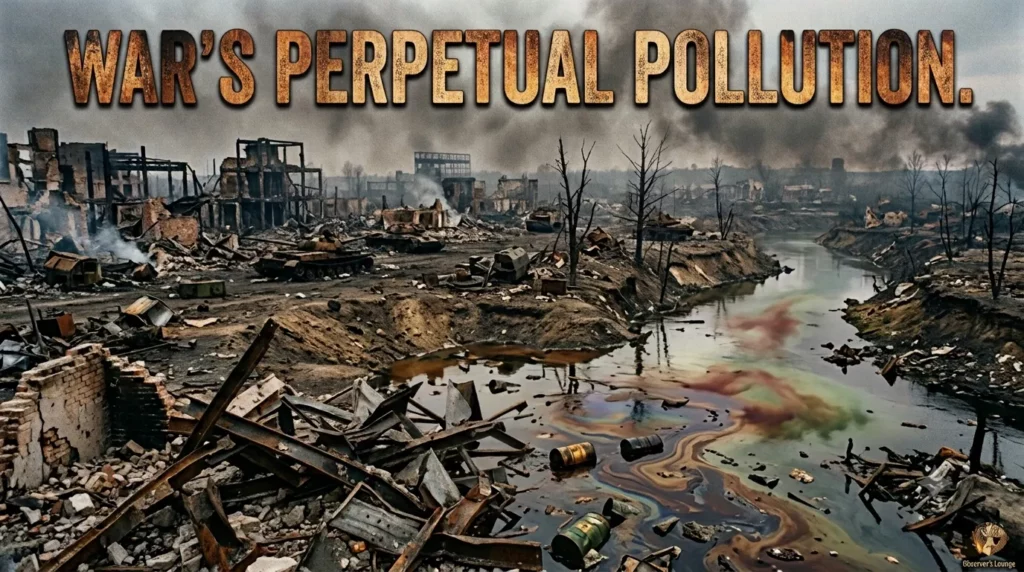
We often view war through the lens of human suffering and the destruction of communities. But while the focus remains on the front lines, the Earth itself serves as a silent, devastating casualty.
War is an attack on the earth itself. It poisons our soil, water, and air, and it doesn’t respect any border. From our groundwater to our food supply, it’s a massive, overlooked driver of the climate problems we’re all trying to fix
We need to stop pretending that destroying the environment is just ‘part of war.’ It’s a direct threat to our health, and it leaves a toxic mess that stays around for generations
The Toxic Legacy: Chemistry That Doesn’t Disappear
Modern weapons are made of toxic heavy metals and explosive materials. They’re built to be persistent, so they keep doing damage long after the smoke clears.
The damage happens in a lot of different ways:
- Persistent Toxins: Heavy metals like lead, mercury, and cadmium, along with materials like depleted uranium and white phosphorus, do not just vanish.
- Contaminated Water: These toxins leach into the aquifers we rely on for drinking and irrigation.
- The Food Chain: Once in the soil and water, these poisons enter our crops and livestock, making their way into the food we eat long after the fighting stops.
The debris crisis starts when buildings are pulverized into mountains of toxic rubble. This mix of asbestos, industrial chemicals, and fuels creates a hazardous disaster zone that keeps poisoning the surrounding area long after the impact.
Then there is the biological contamination. When water treatment plants and sewage systems are destroyed, local waterways turn into breeding grounds for disease. It ruins ecosystems for generations and creates a public health crisis that lasts far longer than the conflict itself.
The Anatomy of Ecological Collapse
Beyond chemical poisoning, the physical mechanics of war actively dismantle the environment’s ability to regenerate.
Soil sterilization happens when high-impact explosions and constant cratering compact the earth, destroying the delicate microorganisms and fungi necessary for plant life and healthy agriculture.
The hidden carbon footprint is a massive institutional issue. While national defense is a recognized state priority, the military’s environmental impact is often treated as an invisible line item.
Militaries are among the world’s largest institutional consumers of oil. The manufacturing of weapons demands a massive amount of energy, and the constant high-altitude emissions from fighter jets fuel the climate crisis. The military-industrial complex is a major driver of global warming.
Open-air burn pits are a common method for disposing of batteries, plastics, and chemicals in many military operations. These pits release thick toxic plumes of smoke that drift across entire regions degrading air quality far beyond the war zone.
The Impacts of War Do Not End When a Treaty is Signed
When the shelling stops the real work of survival begins. Today we see this in the mountains of pulverized concrete that have replaced neighborhoods.
It is a toxic skyline of asbestos and industrial dust that coats everything including the air the water and the soil.
The infrastructure that once sustained a society is gone. With water treatment plants reduced to jagged ruins the pipes are dry or broken.
This turns local waterways into stagnant breeding grounds for disease. This is not just collateral damage because it is the deliberate silencing of a landscape.
As populations are forced into smaller and increasingly fragile pockets of the map, the pressure on the remaining environment is overwhelming.
Every tree is being stripped for fuel and every square foot of land is being pushed beyond its limit.
Even if the conflict were to end tomorrow the poisoned soil and the broken water systems have already created a legacy of suffering that will last for generations.
A Path Forward
Perhaps the most alarming reality is that militaries are frequently exempt from legal obligations to report their carbon footprints or environmental impacts.
This lack of transparency allows the environmental toll of war to remain hidden from the global policy conversation.
If we are serious about sustainability we must shift our perspective. Environmental security is not separate from human security because they are one and the same.
To bridge this gap we must demand:
- Institutional Accountability We must treat environmental destruction as a violation of fundamental human rights rather than a byproduct of conflict.
- Transparent Reporting We need an honest accounting of the carbon cost and toxic fallout of global military operations.
- Infrastructure Prioritization Our efforts must center on the protection and rapid restoration of the water and energy systems that keep a society alive.
War leaves a scar on the land that lasts far longer than the conflict itself. It is time we recognize the environment as a critical pillar of peacebuilding. Because when we poison the Earth, we are poisoning the only home we have.
The conversation does not end here. What conflicts or systemic issues do you see causing harm to our environment? Use the comment section to break the silence. Let’s document this reality together.