
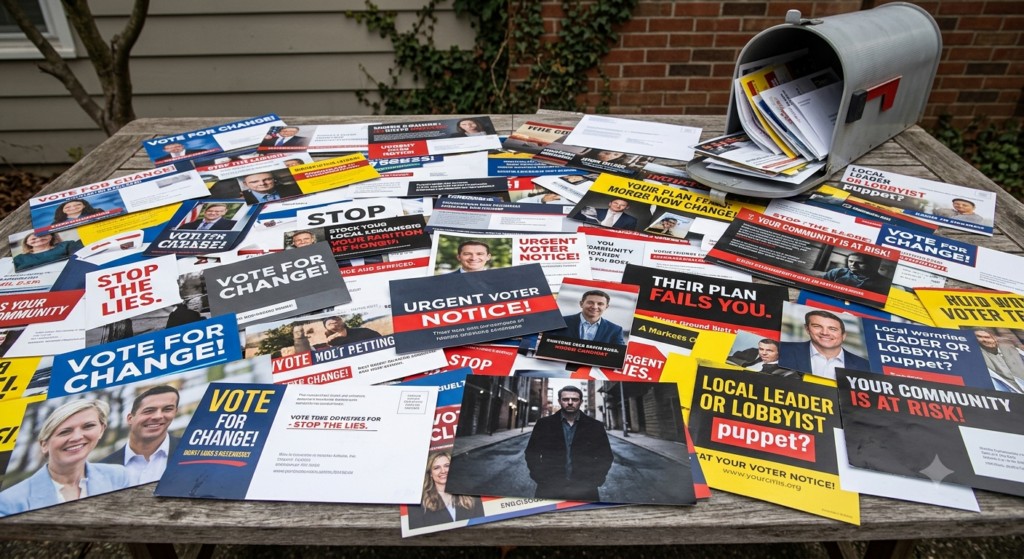
When asking how Super PACs operate in American elections, the answer usually starts with a simple reality, when big outside money moves into a race, it doesn’t want real engagement.
Instead, they flood the zone with campaign ads and attacks playing constantly on screens, radios, and mailboxes, creating an unceasing, manufactured noise that drowns out genuine local conversation. It is a constant, heavy intrusion into daily life.
To understand this landscape, it is helpful to clarify the difference between the two heavy hitters of outside spending: Super PACs and “Dark Money” groups.
The Mechanics of Outside Spending: Super PACs vs. Dark Money
1. Super PACs (Independent Expenditure-Only Committees)
Who they are: Political committees registered with the Federal Election Commission (FEC) that can raise unlimited sums from corporations, unions, and wealthy individuals.
What they do: They spend unlimited amounts on “independent expenditures” (ads, mailers, digital campaigns) supporting or attacking candidates, but legally cannot coordinate directly with official campaigns.
The Disclosure Rule: They are required to publicly disclose their donors to the FEC. On paper, you can look up a Super PAC to see who wrote the checks.
2. “Dark Money” Groups
Who they are: Not a distinct organization type itself, but a term for spending where sources are hidden, typically flowing through 501(c)(4) social welfare groups or 501(c)(6) trade associations.
What they do: Created primarily for advocacy, they are legally allowed to spend a portion of their funds on elections, running ads and mailers to influence races.
The Disclosure Rule: Unlike Super PACs, these non-profits are not required to publicly disclose their donors, keeping the true source of cash hidden from the public.
The Intersection (How They Work Together)
While Super PACs disclose their donors, they frequently intersect with dark money to create a loophole.
A dark money non-profit can funnel millions into a Super PAC.
When you look up the Super PAC’s donor list, you won’t see individual billionaires or corporations, you will only see the name of the non-profit, effectively shielding the ultimate source behind an anonymous shell.
Who Are They? (Play Detective and Pull Back the Curtain)
To understand how this system works, you have to play a little bit of Sherlock Holmes with your mailbox.
Those glossy, high-budget mailers attacking local candidates don’t drop out of thin air.
They are funded by money passed through a chain of intermediary groups that never have to reveal who is actually footing the bill.
By the time that cash hits your local race to fund an avalanche of ads, the true source is hidden behind an intentionally vague, patriotic-sounding name designed to trick anyone who isn’t paying close attention.
While a massive wave of voters is waking up and seeing right through the noise, there are still plenty of people who take those glossy flyers at face value.
Unmasking the real players takes a bit of digging… looking past the slick paper, checking who actually registered the committee, and following the paper trail to see which corporate interests are desperate to keep their names out of the spotlight.
Channel Your Inner Sherlock: How to Unmask the Hidden Donors
When that glossy mailer hits your mailbox or a fast-talking ad flashes across your screen, don’t just toss it in the recycling bin, investigate it.
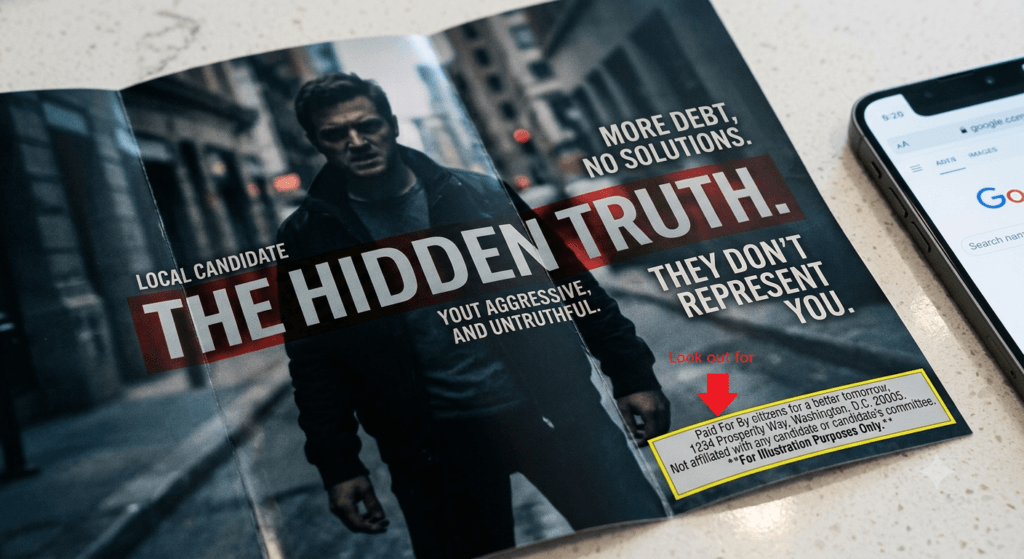
Finding out who is actually paying for the noise takes just a few quick steps on your phone:
Watch the TV Screen for the Fast-Talk Disclosures: On television or digital video ads, listen to the very end where the voiceover rushes through a disclaimer at lightning speed, or look at the small text at the bottom. If it’s funded by an outside group rather than the candidate’s official campaign, that’s your first major clue.
Hunt for the Fine Print On Mailers: Flip the mailer over or look at the tiny text on the screen. Look past the generic, patriotic-sounding name (like “Citizens for a Better Tomorrow” or “Future Leadership Fund”) and find the actual registered committee name or filing ID.
Run a Quick Search: Plug that exact committee name into a search engine or specialized public disclosure databases like OpenSecrets.org or FollowTheMoney.org.
Follow the Paper Trail: Check who actually registered the group and where the money originated. Often, you will find that a slick local-sounding group is actually funded by an out-of-state mega-donor, a corporate lobbying group, or a chain of anonymous shell nonprofits trying to keep their real motives hidden from your neighborhood.
Once you look past the glossy paper and run the names, the illusion shatters immediately. You realize the whole thing isn’t grassroots community concern, it’s a corporate footprint.
The Cost, The Effects & The Future
The immediate casualty of this system is grassroots competition. When everyday citizens step up to run for local office, they realize they aren’t just running against another candidate, they are running against an invisible wall of corporate cash.
Independent voices get drowned out by wave after wave of manufactured attacks designed to exhaust local challengers.
This sends a clear warning to anyone thinking about running that without establishment approvals, attacks are coming.
Long after the ballots are counted, the real consequences set in. Politicians propelled into power by dark money prioritize corporate agendas at the expense of the constituents they were elected to serve.
The Awakening & The Future
But the old trick of buying an election is finally starting to lose its grip.
When people open their mailboxes day after day to find yet another identical, high-gloss attack ad funded by an out-of-state group, they aren’t fooled anymore, they are just annoyed.
Voters are recognizing that these massive spending sprees aren’t trying to help the community, they are trying to buy it.
Looking ahead, the future of our local elections hangs in the balance as digital tracking and dark money tactics grow more sophisticated.
The ultimate defense isn’t more regulation from the top down, it’s an informed, vigilant public from the bottom up.
Once you see the strings, the illusion completely falls apart.
Call to Action
Don’t let your mailbox and your screen be hijacked without a fight.
The next time a glossy mailer lands on your table or a rapid-fire ad flashes across your television, take two minutes to play the detective.
Flip it over, find the fine print, and run the name though the search engines. Share what you find with your neighbors and talk about who is really trying to pull the strings in your community.
When we stop letting anonymous money operate in the shadows, we take back our local elections one unmasked flyer at a time.
What’s Your Take?
What are your thoughts on dark money in our elections?
Have you spotted these glossy mailers in your mailbox, and how do you cut through the noise to find out who’s really behind them?
Remember, sharing is caring, let us know in the comments!