
 The buzz around socialism is louder than ever, and that’s saying something. Let’s face it, when everyday folks start talking about the stuff of economics, you know something big is stirring.
Real lives are feeling the pinch. So why is socialism is gaining popularity? It boils down to how current economic systems just aren’t cutting it for a lot of people.
Economic inequality has stretched to a point where folks are asking, ‘Is it supposed to be like this?’
Standard wages aren’t holding up anymore. Everything costs more, from rent to groceries, and people are left wondering why they work so hard yet can’t seem to catch a break.
It’s a valid question, and the default answers aren’t satisfying the masses.
Many feel that the promise of upward mobility is becoming a farce.
Working hard is no longer the ladder to a better life. It’s more of a treadmill, where you hustle hard but stay stuck in the same spot. No wonder people are looking for alternatives.
This is where socialism’s appeal starts making sense. Offering ideas of economic support and equity, socialism speaks to the needs that capitalism seems to overlook.
At its core, the rising interest in socialism is more like making sure everybody gets a fair shake.
Folks want the basics:
- healthcare
- education
- a roof over their head
Folks just want these basic wants without having to sell their soul for a paycheck that barely covers the essentials.
They’re not looking for handouts, they’re asking why basic needs can’t be guaranteed by a society that has plenty.
This shift in thinking isn’t confined to manifestos or political rallies either. It’s reflected in conversations over the dinner table, online debates, and community meetings.
People have started comparing notes with folks from other countries, seeing what works elsewhere, and it opens up new expectations.
The ripple effect is real, and socialism’s growing popularity is just one piece of this changing puzzle.
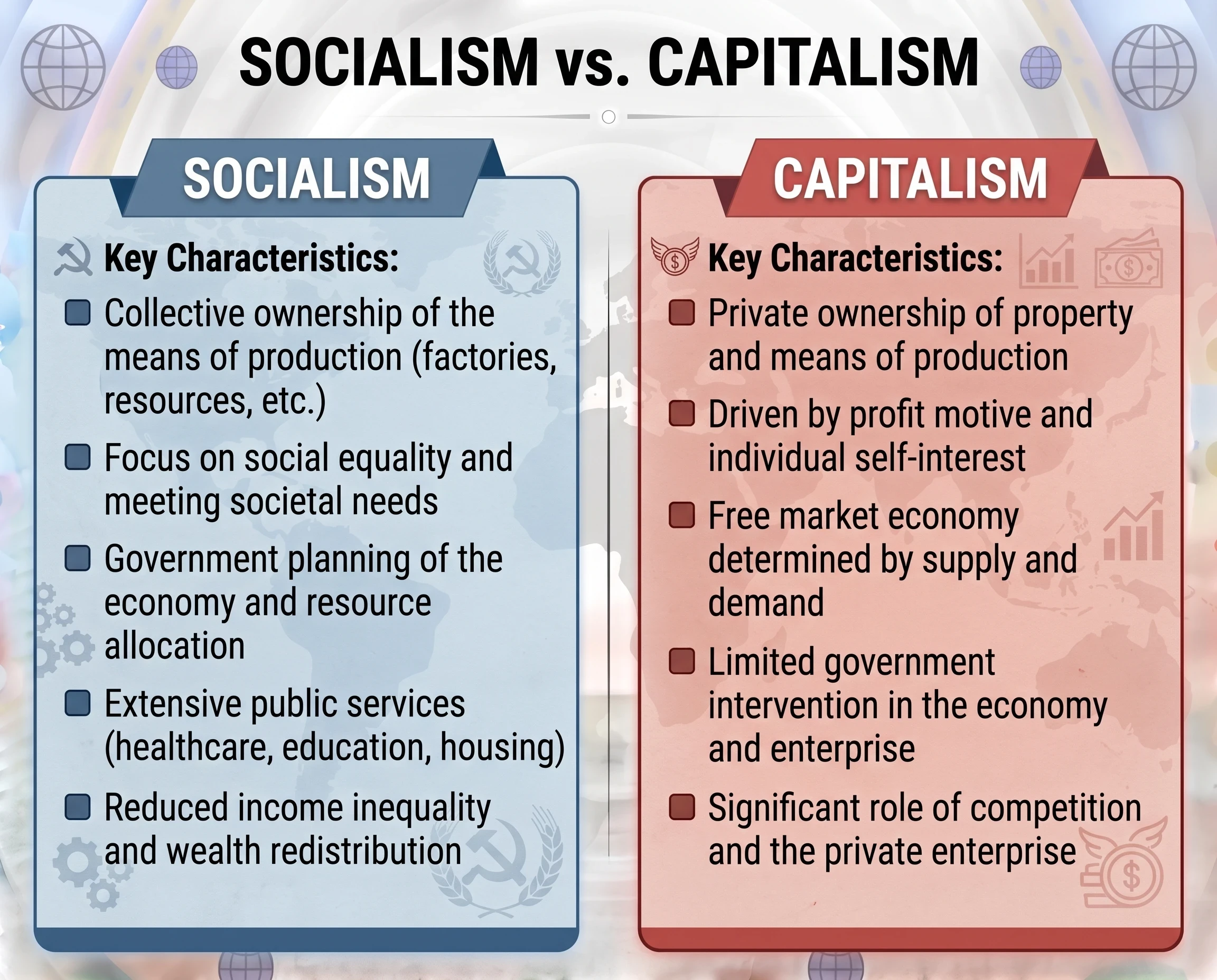
To figure out why the traditional rules of the game aren’t working anymore, it’s worth taking a closer look at the core mechanics of capitalism and socialism side by side.
CAPITALISM
- Core Principle: Private ownership of the means of production and their operation for profit.
- Mechanism: Driven by free markets, competition, supply, and demand.
- Focus: Individual economic freedom, accumulation of private wealth, and market efficiency.
- Goal: Economic growth, innovation spurred by competition, and market-based solutions.
- Potential Pitfall: Can lead to significant wealth inequality, economic instability (booms and busts), and a market that may not provide for essential public goods (like healthcare) if they are not profitable.
SOCIALISM
- Core Principle: Social or public ownership of the means of production and cooperative management of the economy.
- Mechanism: Often involves significant government planning, regulation, and public provision of key services.
- Focus: Collective well-being, economic equality, and decommodification of basic needs.
- Goal: Meeting human needs (healthcare, education, housing) over maximizing profit, and ensuring a social safety net.
- Potential Pitfall: Can potentially lead to reduced individual incentives for innovation, slower economic growth overall, and bureaucratic inefficiencies if not managed correctly.
The Cost-of-Living Squeeze: Economic Challenges Today
Wages just aren’t what they used to be. You work your fingers to the bone, but somehow, the paycheck feels a bit lighter every month.
People everywhere are grappling with this new reality where making ends meet feels like pulling a rabbit out of a hat.
And it’s not like wages are shrinking it more like everything else is just getting so darn expensive.
Take your daily costs:
- housing
- groceries
- utilities
All basic things, right? Well, they’re ballooning out of control.
For middle-income earners, it’s tough. For those earning less, it feels impossible.
It’s like you’re running a marathon, uphill, in the rain, wearing nothing but flip-flops and you’re freezing because the heating bill is too darn high.
And then there’s the talk about upward mobility. The story goes, if you grind hard enough, you’d climb up the life’s ladder and get that house, a good car, maybe a better neighborhood.
Now, it’s more like running hard but getting nowhere. You know like a treadmill perfectly rigged to keep you right where you are.
It’s this sensation of being stuck that’s challenging confidence in the current economic systems.
Living costs have turned the necessities into luxuries, and for many, it feels like the system is choking them.
The high rent or pricey groceries is a creeping realization that basic survival is so linked to money.
Is it any wonder then that people are yearning for change, for a different way that ensures stability and peace of mind?
For those on the ground, the story is the same across the board. Families want to know why they’re working double shifts and cutting coupons, yet sinking deeper into debt.
Folks are looking for solutions, the first step is understanding why things are this way.
Armed with knowledge, we can press for policies that offer:
- real relief
- fair wages
- affordable housing
- make sure everyone can make a life, not just a living
Dispelling the Myth of Infinite Growth
In the chase for economic growth, we’ve been sold on the idea that growth can stretch on forever, like some magical beanstalk.
But here’s the kicker, infinite growth in a world with finite resources just doesn’t add up.
It’s like trying to fill a bucket that has a hole in it. For the average person, carrying the brunt of this unrealistic ideal is an endless grind with very little to show for it.
Now, think about it, this economic model based purely on extraction tends to stockpile benefits at the top, while the people at the bottom which are your regular everyday folks, bear most of the risks.
Imagine hiking uphill while those at the peak watch and benefit from your every step without sharing in that climb.
The support for democratic socialist ideas often doesn’t come from a place of rebellion, but rather a plea for fairness and balance.
People aren’t against growth, they just want growth that benefits everyone, not just a select few.
They want an economy where the risks and rewards are more evenly distributed and where everyone has a chance to benefit from the fruits of collective labor.
Discussions about these concepts, once reserved for academic settings or political rallies, are happening everywhere.
From coffee shops to living room debates and social media threads, people are questioning the status quo.
They’re fed up with the stale arguments that tout unrestricted growth as the silver bullet for every problem.
Instead, there’s a growing realization that our systems need a bit more heart, a balance between competitive drive and community support.
Many are looking to examples of democratic socialist principles in action like,
- universal healthcare
- access to education
- public infrastructures that serve everyone, not just a privileged few
They see these policies not as threats to freedom or entrepreneurial spirit but as foundational to a stable and secure society.
It’s all about making it work for more, if not all of us.
Defining the Path Forward: Capitalism Vs. Socialism in 2026
So, where do we go from here?
With capitalism and socialism each having their own merits and their fair share of flaws, the real work lies in figuring out how to blend the best of both worlds.
Imagine crafting a system where the dynamism of a market economy coexists with the empathetic safety net of social policies. It’s generally working hand in hand.
Policies like universal healthcare, affordable housing, and robust public transit have long been dismissed as too costly or unattainable in capitalistic countries.
But as costs of living rise, these ‘radical’ ideas are starting to look a lot like common sense. It’s basically guaranteeing the basics so nobody has to choose between medicine and rent.
Countries doing well often have some mix of socialism and capitalism. Take Germany with its impressive public healthcare or the Nordic countries with their strong social safety nets.
They’re doing something right. Learning from those models, we can design something uniquely suited to local needs while also drawing from what’s successful elsewhere.
Public sentiment is shifting. What used to be dismissed with buzzwords or thrown into the ‘that can’t work here’ pile is now being revisited with fresh eyes.
The public is asking for transparency, accountability, and fairness, and rightly so.
There’s a demand for leadership that offers clear, actionable solutions instead of padded statistics and empty promises.
As we move towards 2026, the conversation isn’t just going to be about dismantling established norms but rebuilding and refining them to ensure every individual feels secure, valued, and heard.
By balancing the scales, we empower people not just to survive but to thrive in a new, integrated economy that makes room for everyone.
Where do you draw the line? Are we reaching a breaking point with the cost of living, or can our current system still be fixed from within?
Drop your thoughts in the comments below, and let’s keep the conversation going.