
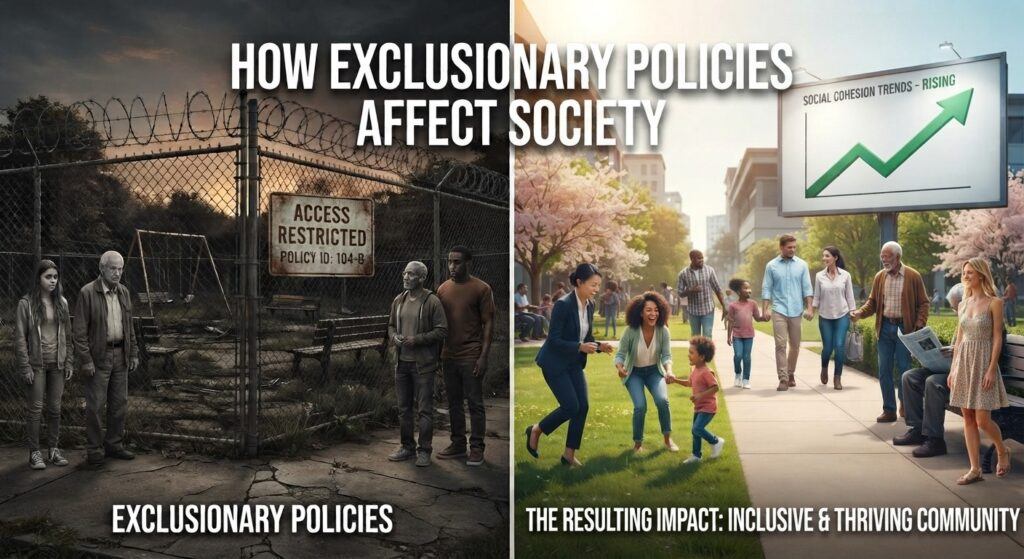
How exclusionary policies affect society is no longer a theoretical debate, it is an economic reality written in rising prices and stagnant growth.
We live in an economic ecosystem that increasingly rewards political theater over actual math, trading long-term prosperity for the cheap, fleeting high of division.
Whether through the self-inflicted wounds of mass deportations or a broader cultural appetite for performative hostility, we are actively choosing to shrink our own potential.
True economic health relies on inclusion, yet we keep chasing the illusion of manufactured scarcity.
The Self-Checkout Economy
Let’s stop pretending that sealing borders, pushing people out, or erecting sweeping trade barriers is an act of economic protection. It’s an act of self-sabotage.
History shows a very predictable cycle, whenever a nation attempts to legislate economic strength by locking out international trade and labor dynamics, it ends up choking domestic production.
When governments lean into protectionist walls and broad import restrictions, the immediate result is restricted supply chains and acute shortages.
Domestic industries lose access to vital inputs, consumer prices spike, and retaliatory barriers inevitably slam shut on local exports. It’s an artificial squeeze that acts like a tax on everyday life.
The numbers from heavyweights like the International Monetary Fund (IMF) and the Congressional Budget Office (CBO) don’t mince words about the opposite approach:
- The Growth Dividend: IMF research shows that a healthy, integrated influx of workers and open trade channels boost long-term GDP per person, directly driving productivity.
- The Fiscal Cushion: CBO analyses repeatedly demonstrate that robust labor force growth adds trillions to the broader economy, expands the tax base, and takes the structural weight off public systems.
It’s an old, fundamental economic truth: Once everybody makes money, everybody makes money.
Look at open economies that lean into integration, they expand the economic pie. Contrast that with economies built on division and universal trade walls, which inevitably get trapped in a loop of inflation and stagnation.
The Real Price Tag: From Fields to Checkouts
When a society chooses exclusion, the pain doesn’t stay abstract, it hits checkout lanes and supply chains immediately.
Mussolini’s infamous Battle for Grain in the 1920s and 30s is a historical masterclass in this folly. By forcing agricultural priorities through rigid, isolationist decrees regardless of geographic or labor realities, he disrupted efficient markets, created artificial shortages, and drove up the cost of basic staples for everyday citizens.
When a society tries that playbook today, it faces sudden labor lockdowns or mass workforce contractions. The same thing happens, millions of dollars worth of fresh produce rot in the fields while consumer prices spike by double digits.
When you manufacture a labor shortage, everyday people pay the markup. Everything from groceries to housing gets tighter and pricier, shrinking public revenues and straining municipal budgets in the process.
Growth vs. Grievance: The Fascist Trap vs. Durable Progress
History tells a very predictable story about leaders who choose division. Societies that prioritize structural investment and opportunity thrive, those hooked on grievance-led policies stall out.
Think of the architects of post-war European labor agreements or modern nations with structured, points-based integration models. They built bridges, and their economies roared.
Now look at the alternative: Leaders obsessed with performative hostility. Mussolini whipped up explosive nationalist fervor while systematically destroying domestic economic efficiency and dragging Italy into backwardness.
Swap the era, and the script doesn’t change much, modern politicians trading hard policy substance for theatrical grievances end up trapped in the exact same cycle of decay. They mistake shouting for strength, and the economy pays the price.
Choosing a Path Forward
The data, the history, and the daily headlines point to the same exit ramp. Future-proofing our nation means recognizing that real strength comes from building up our collective capacity, not walling ourselves off.
It’s time to trade the cheap high of grievance for the hard, rewarding work of durable growth.
Join the Conversation
What path should our communities take moving forward? Are we building toward a shared, inclusive future, or getting caught in the loop of division?
- Share Your Thoughts: Drop a comment below and let us know how you see these economic trends playing out around you.
- Keep the Discussion Going: Subscribe to Observer’s Lounge on Substack for weekly deep dives.
Thanks!