
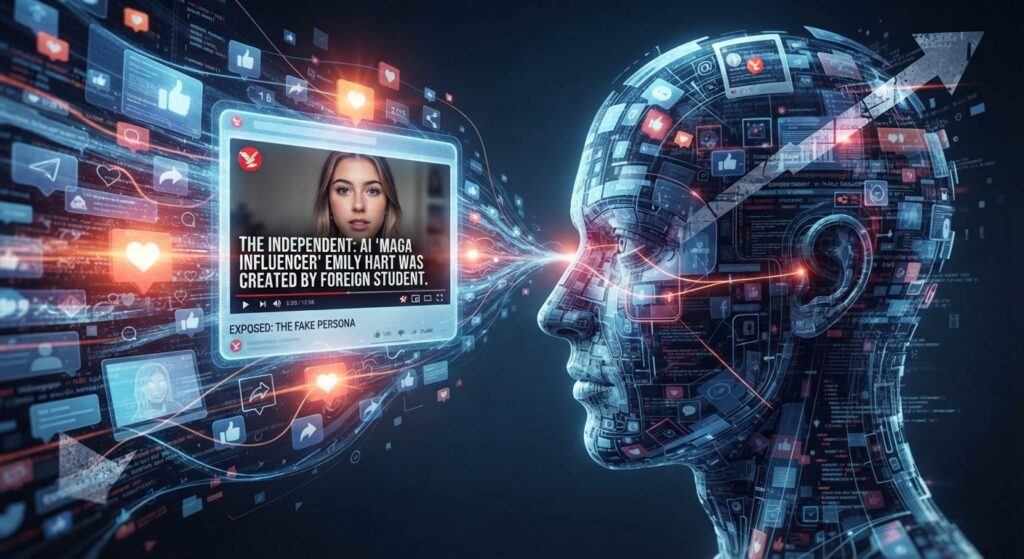
Social media platforms like TikTok, X, and Meta are shaping what we think. Their secret weapon is engagement-driven algorithms. These sneaky little codes figure out what you’d maybe like to see based on the stuff you’ve clicked, liked, or shared before.
These algorithms love to dish out content that hits you right in the feels. You’ve might have experienced this, you know, stuff that might make you angry, happy, or just plain shocked.
Ever wonder why your feed seems to just spill out what you already know and love? That’s because these algorithms wanna keep you on their sites for as long as possible by echoing back what they think you vibe with.
Now, here’s where things get a bit messy. The entire system is gamed. Between automated bot farms, foreign interference, and bad actors deploying sockpuppet accounts or AI-generated personas, a huge chunk of online outrage is entirely manufactured. (Case in point: the viral saga of the foreign medical student who built a massive following pretending to be an American political influencer using AI.) The algorithm loves this chaos because outrage drives clicks, but it’s essentially digital smoke and mirrors designed to play you
By showing you content that matches your existing opinions and mixing in engineered outrage from fake profiles, you end up in a digital bubble where reality gets warped. It’s like being in a room full of people yelling the same thing, except half those voices might not even be real people.
The issue here is that these loops slow down real democratic debate and replace it with performance. If you’re constantly fed a diet of artificial rage and one-sided narratives, your ability to see the actual playing field takes a hit.
Anatomy of a Viral Hoax: How Foreign Footage Was Repurposed to Manufacture Panic in Dearborn
As local tensions and demonstrations drew attention to the Dearborn City Council meeting, the digital ecosystem flooded with recycled viral media designed to inflate fear and manufacture outrage.
Chief among them was a viral TikTok post claiming that a massive convoy of 20,000 bikers was descending on the city. Complete with dramatic flame emojis and an “IYKYK” caption, the post sought to paint an intimidating picture of an invading force.
There is just one problem: The footage is entirely foreign, digitally altered, and completely unrelated to Michigan.

The Visual Mismatch: On the left, a TikTok screenshot pushes the narrative of a rally heading to Dearborn, Michigan. On the right, the actual source footage reveals a completely different geographic landscape.
Exposing the Stitch Job
When looking closely at the pixels, the mechanics of how these synthetic panic narratives are built become clear:
- The Mismatched Highway Lines: While the general layout of the highway resembles major multi-lane motorways, forensic comparison reveals subtle inconsistencies in lane dividers and foliage angles. This indicates that the creators clipped, spliced, or flipped foreign video segments to disguise their origin.
- The Dead Giveaway (Where Are the Flags?): Any authentic domestic populist or nationalist demonstration in the United States, echoing visual precedents like the crowds seen during January 6th, is blanketed in American flags, banners, and national iconography. In this viral video, not a single American flag is visible anywhere in the massive crowd.
- The True Origin: The core video footage actually dates back to a massive 2021/2022 memorial ride in Germany held to fulfill the final wish of a terminally ill 6-year-old boy named Kilian. Bad actors routinely strip touchingly human footage out of its context overseas, slap a brand-new localized text overlay on top of it, and unleash it onto the algorithm to exploit real-world calendar dates.
For readers who want to verify the receipts themselves, the original footage can be played above.
By moving past the viral hype and looking at the actual evidence, it becomes clear that the digital narrative was built entirely out of imported fiction.
The Influence of Content Creators: Manufactured Relatability
Scrolling through your feed, it’s impossible to avoid content creators blending everyday lifestyle content with heavy political commentary. For a lot of people, especially younger audiences, these voices feel infinitely more authentic than a traditional news anchor reading off a corporate teleprompter.
The secret sauce is manufactured relatability. Speaking directly from their cars, kitchens, or bedrooms, these creators package political talking points alongside daily routines to make you feel like you’re getting advice from a trusted friend rather than a formal lecture. It lowers your guard, making complex or radical ideas instantly digestible.
But let’s be completely honest about what’s actually happening here, that “buddy-next-door” vibe is often a calculated strategy. Over time, creators build parasocial trust with their followers, and that trust is a massive commodity.
A single post can carry enough weight to shift public opinion, drive fundraising, or weaponize outrage. And as we’ve already seen with synthetic AI accounts and foreign-backed sockpuppets, you can’t even guarantee the person talking to you from that kitchen is a real human being, let alone an independent thinker.
Even among real creators, political commentary rarely comes without an agenda. Whether they’re chasing monetization, algorithm boosts, or marching to the beat of an organized political network, influencers are selling a curated narrative.
The takeaway: Stop treating social media personalities like trusted advisors. When a creator is trying to sell you political outrage disguised as casual conversation, step back, check the incentives, and remember that manufactured charm is just another tool designed to play your emotions for clicks.
Direct Candidate Communication: Bypassing Accountability
Politicians have figured out how to cut out the editorial middleman entirely. Gone are the days of sitting down for a tough interview with a journalist who might actually challenge their record. With a quick post or a livestream, they can beam their message straight to supporters, completely unfiltered and entirely on their own terms.
It’s a calculated control tactic. By bypassing traditional gatekeepers, political figures can control the narrative, ignore hard questions, and avoid any real accountability. Need to dodge a scandal or skirt around a weak voting record? Just drop a polished 30-second video, turn off the comments, and let the algorithm do the heavy lifting.
And let’s look at how these platforms actually operate on the backend. Between shadowbanning, targeted content suppression, and heavily curated comment sections where dissenting voices get scrubbed or buried, what looks like “direct communication” is often a tightly managed illusion. It trades deep policy discussions for snappy soundbites and engineered outrage because nuance doesn’t go viral.
The reality check: Stop expecting politicians to give you substance on platforms built for quick dopamine hits. When a candidate bypasses the press to speak “directly” to you, remember they are only showing you what they want you to see.
Instead of waiting around for soundbites to make sense, tune out the self-produced PR campaigns. Look to independent tracking tools, public legislative records, and investigative journalists who actually dig into the numbers because a politician’s social media feed is a campaign ad, not a public service.
Polarization vs. Mobilization: Breaking the Outrage Cycle
Social media pulls us in two opposite directions at once. On one hand, it’s an unprecedented megaphone, a hashtag can spark a movement, organize communities in minutes, and get people to the polls faster than traditional organizing ever could.
On the other hand, it’s a machine built to fracture us. The algorithms don’t care about unity, they care about adrenaline. They reward extremism and widen the gap between differing views, turning what should be civic discussion into a 24/7 digital cage match.
Add in a flood of deepfakes, manipulated clips, and synthetic media engineered to trigger instant outrage before facts even enter the room, and voters aren’t just navigating biased opinions anymore, they’re fighting an uphill battle against weaponized reality.
So, how do you survive it? You stop playing the game.
Forget the idea that you need to fix the comment section, bridge every political divide online, or Zen your way through bad-faith arguments. The block button isn’t a retreat, it’s a boundary. You don’t owe bots, trolls, or algorithmic outrage peddlers a single second of your attention.
When a post makes your blood boil instantly, treat it like a trap. Check the source, question the incentive, and most importantly, log off. Real political power isn’t won by who gets the last word in a viral thread, it’s shaped by real-world actions, local results, and what happens outside of your glowing screen. Shifting the narrative starts by starving the noise of your attention.
What’s Your Take?
Stop scrolling, tune out the algorithmic noise, and join the conversation.
Drop your thoughts in the comments below, and if you know someone who’s still letting social media feed them outrage, share this article with them.