
We have all experienced the ritual. You walk up to a counter, order a black coffee or pick up takeout you drove across town to retrieve yourself, and the cashier swivels a touch-screen tablet around to face you.
Prompted by pre-selected buttons starting at 18%, 20%, and 25%, you are forced to make a public, moral calculation in three seconds flat.
It is called “tipflation,” but calling it inflation misses the point. This isn’t a natural market shift, it is behavioral engineering.
What began as a cultural gesture of appreciation for sit-down service has been industrialized into a corporate payroll subsidy.
Businesses and delivery apps have discovered that if they guilt-trip the customer at the checkout counter, they can keep baseline wages pinned to the floor while preserving their own operating margins.
Even worse, this setup intentionally manufactures conflict between the two groups with the least power, the exhausted consumer paying a premium, and the desperate worker fighting for rent money.
Crowdfunding the Payroll
In our previous breakdown on The Triple-Hustle Economy, we laid out the cold math: entry-level compensation hasn’t kept pace with shelter, utilities, or vehicle costs.
When an unexpected $250 escrow hike hits your monthly mortgage or your auto insurance jumps 20%, you don’t turn to gig delivery apps because it’s fun side money. You do it because you need cash to plug a leak in the household boat.
Yet look at how the app model actually functions:
- The Customer Markup: Grocery prices on delivery platforms are marked up well above in-store shelf tags, accompanied by service fees, delivery fees, and regulatory surcharges.
- The Courier Payout: Despite those fees, base pay for the delivery driver frequently hovers at a meager $2 to $3 per run.
- The Guilt Bridge: The platform suggests that the customer bridge the massive shortfall through tips so the courier can make minimum wage.
The company skims pure margin off both ends, while orchestrating a vertical labor grievance (worker vs. employer) into a horizontal culture war (courier vs. customer).
When a customer leaves a modest tip, the driver feels insulted. When an order sits cold because drivers decline an unprofitable trip, the customer blames the worker. Corporate leadership remains completely untouched by the backlash.
The Myth of the “Unprofitable” Gig App
For years, Silicon Valley venture capitalists and PR spin doctors sold the public a convenient excuse, “Delivery apps aren’t making any money. If we pay drivers more or eliminate fees, the whole system will collapse.”
That was a calculated narrative designed to buy time while they cornered the market. Today, the excuse is dead in the water.
These platforms aren’t bleeding cash anymore, they have matured into cash-generating extractive monopolies:
| Platform | Annual Revenue | Free Cash Flow / Profits | Base Pay to Couriers |
|---|---|---|---|
| DoorDash | $13.7B+ | $2.2B Free Cash Flow (~$930M Net Income) | $2.00 – $3.00 per trip |
| Instacart (Maplebear) | $3.7B+ | $910M+ Free Cash Flow (~$1B in ad sales alone) | $4.00 – $7.00 per batched order |
| Uber (Eats & Mobility) | $43B+ | $6B+ Free Cash Flow (Authorizing multi-billion buybacks) | $2.00 – $3.50 per food drop |
Look closely at those balance sheets:
- DoorDash pulled in over $13.7 billion in annual revenue, generating more than $2.2 billion in pure free cash flow.
- Instacart raked in over $3.7 billion in revenue, posting nearly $1 billion in free cash flow. Over $1 billion of their business isn’t even from delivery fees, it’s from selling digital ad space to food brands on the backs of orders fulfilled by couriers.
- Uber is throwing off over $6 billion in annual free cash flow and authorizing multi-billion-dollar stock buybacks to reward executives and Wall Street shareholders.
When a corporation produces billions in free cash flow and turns around to buy back its own stock, they can afford to pay a living hourly wage.
They simply choose not to. Why spend company profits on base pay, vehicle maintenance stipends, or worker injury protections when an iPad swivel and a customer guilt prompt will pick up the tab for free?
The True Cost: Burning Personal Capital
The illusion of gig work is “independence.” The reality is an aggressive offloading of operational liability.
When you drive for an app, you aren’t just giving up your free hours, you are actively liquidating your vehicle’s lifespan. You are burning $5-a-gallon fuel, wearing down brake pads, chewing through tires, and putting thousands of heavy city miles on the very car you need to get to your primary job on Monday morning.
A driver who grosses $800 in a grueling 40-hour gig week quickly discovers that after gas, maintenance reserves, and the 15.3% self-employment tax burden, their net hourly wage drops down to $12 or $14 an hour. The platform didn’t hire a worker, they leased a private vehicle and driver at below-market depreciation rates.
The Safety Deficit
Beyond the financial trap lies a darker reality that platform commercials never show, the physical danger of solo gig work.
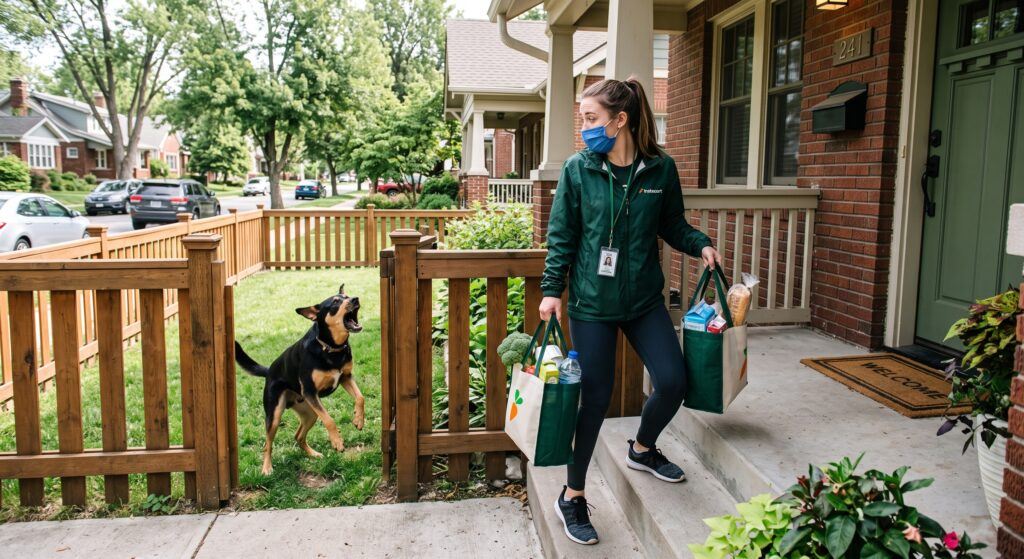
Couriers routinely navigate unfamiliar neighborhoods after dark, climbing unlit porch steps, dodging loose dogs, and facing hostile homeowners who treat an unexpected presence on their driveway as an intrusion.
Yet platforms actively enforce a “solo worker” policy, penalizing drivers who bring a friend, spouse, or sibling along to watch the car or watch their back.
Couriers are left alone in high-risk environments with zero security, no hazard pay, and automated in-app chat bots that offer scripted platitudes if something goes wrong.
Add the algorithmic guillotine to the mix, where three batched grocery runs must be completed on razor-thin deadlines, and an algorithm threatens account deactivation the moment a customer satisfaction score dips below 4.7 stars, and the psychological toll becomes overwhelming.
Time to Drop the Screen
The solution isn’t to snap at counter staff, nor is it to demand that tapped-out working-class customers double their tips to offset billion-dollar tech platforms.
Real accountability means:
- True All-In Pricing: Eliminating junk service fees and requiring platforms and hospitality businesses to display the real, total price upfront.
- Ending the Sub-Minimum Wage Exemption: Paying workers a genuine, living base hourly wage out of company revenue rather than customer guilt.
- Portable Benefits and Liability Protection: Forcing app monopolies to carry proper commercial injury and hazard insurance for the couriers generating their platform volume.
Until we redirect our frustration toward the corporate suites engineering the pay cuts, the iPad swivel will remain what it has always been: a distraction designed to keep our eyes on the tip jar instead of the balance sheet.
Join the Discussion at Observer’s Lounge
Have you felt the point-of-sale squeeze as a consumer, or taken on delivery gig shifts just to stay ahead of rising bills? Where should the line be drawn between tipping for good service and subsidizing corporate payroll?
Drop your perspective in the comments below. If you believe in independent, data-driven commentary on modern labor, policy, and working-class realities, subscribe to our Substack newsletter so you never miss a piece.