
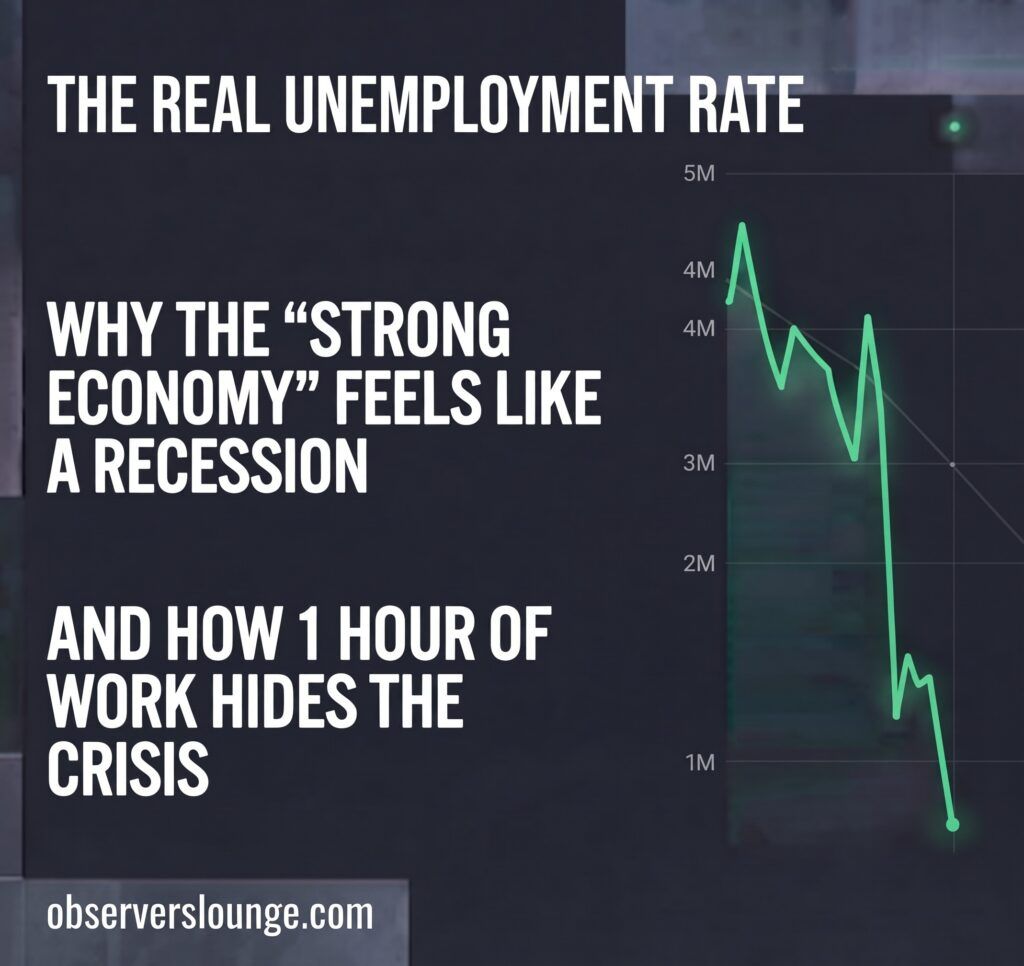
Every month, the federal government steps up to the podium to announce that the American labor market is “resilient.” Unemployment numbers hover near record lows, headlines celebrate economic strength, and politicians declare that anyone who wants to work has a job.
Yet outside the press briefing rooms, everyday life tells an entirely different story.
People are driving for Uber after work. They are delivering food orders in older sedans just to buy groceries. They are selling plates of home-cooked food out of their home kitchens, vending on street corners, running side hustles, writing articles, live streaming and chasing algorithm dreams on YouTube Shorts and TikTok by grinding 60 to 70 hours a week across three different apps just to cover a rent payment that keeps climbing.
If the labor market is so great, why is half the country scrambling to survive on tips, unpredictable gig payouts, and creator pennies?
The answer lies in a dark truth about how the government counts “employment.” Once you see how the math actually works, the illusion falls apart.
The One-Hour Loophole: How the Government Counts You
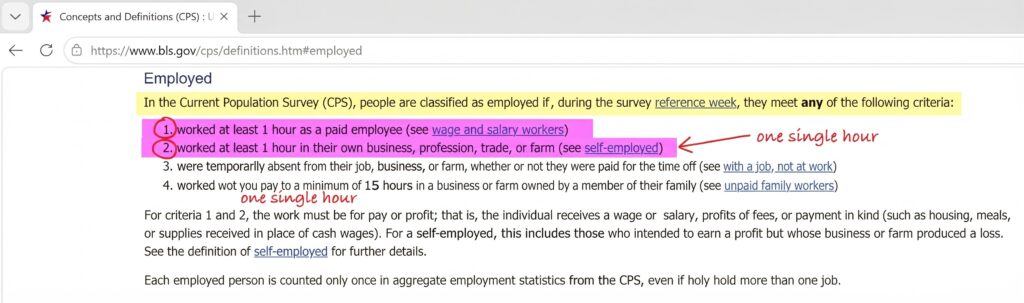
What This Actually Means for the Real World: Notice what the government’s definition leaves out: there is no minimum wage threshold. The BLS doesn’t care if you made $5,000 from a corporate paycheck or $5 from a creator ad-share payout, a freelance gig, or selling a single item online. If you worked one single hour and made even a few pennies “for pay or profit,” Washington checks the box and counts you as fully employed. That’s why the official unemployment rate can look gleaming on paper while everyday life feels like a silent recession.
The headline unemployment number everyone hears about the U-3 rate comes from the Current Population Survey conducted by the Bureau of Labor Statistics (BLS) and the U.S. Census Bureau. Every month, they poll about 60,000 households.
Here is the exact federal definition of what makes someone “employed”:
If you did at least one hour of work for pay or profit during the survey reference week, you are officially counted as Employed.
Read that again: One single hour.
- If you get laid off from a $90,000 corporate job, cannot find a replacement for six months, and turn on DoorDash for two hours on a Tuesday to earn $22, you are not unemployed according to the BLS.
- If you set up a table on a sidewalk to sell snacks or craft items for an afternoon, you are employed.
- If you run a YouTube channel or write posts hoping to monetize one day and make $5 in ad share, you are employed.
The survey does not ask whether your job offers healthcare, paid sick leave, retirement contributions, or enough money to keep an apartment. It only asks, Did you earn any money?
In previous decades, if you got laid off, you filed for unemployment, searched for an opening, and waited. The government counted you as unemployed. Today, modern app platforms have stripped away all the hiring friction. There is no interview, no background screening delay, and no formal onboarding. You download an app, verify your driver’s license, and start delivering within 48 hours.
The gig economy has turned into an algorithmic shock absorber that catches displaced workers and magically wipes them off the official unemployment statistics.
The Trap of the Hustle Economy: Transferring All the Risk
The government loves calling this “entrepreneurship” and “independent contracting.” In reality, it is a massive transfer of corporate operational risk directly onto the worker’s back:
- The Fuel and Maintenance Tax: When gas prices surge due to Middle Eastern shipping blockades or geopolitical conflict, the corporate platforms don’t absorb that cost, the driver does. Every tire change, oil change, and mechanical breakdown comes directly out of your take-home pay.
- The Tip Mirage: Many gig apps pay a base fee of just $2 to $3 per task, relying on the customer to supply the rest via tips. When consumers cut back discretionary spending, tips collapse. After factoring in fuel and self-employment taxes, thousands of gig workers are netting far below the federal minimum wage.
- The Invisible Safety Net: 1099 workers receive no worker’s compensation, no employer-matched Medicare/Social Security, and zero health coverage. It prevents an immediate eviction, but it creates zero long-term financial security.
The Digital Monetization Carrot: Moving the Goalposts
For people trying to hustle through media, writing, or content creation, the landscape is equally brutal.
Platforms dangle the promise of monetization, but set thresholds that filter out 99% of normal human beings:
- On YouTube Shorts, you need 10 million views in 90 days (or 4,000 public watch hours on long-form video) plus 1,000 subscribers just to enter the Partner Program.
- On TikTok, payout funds have been repeatedly slashed, demanding millions of qualified views for payouts that barely cover a weekly grocery run.
Algorithms are deliberately designed to keep creators producing endless, high-frequency short-form content for free, feeding the platform’s ad inventory while returning fractions of a penny to the person making the content.
People aren’t doing this because they want to “get rich quick.” They are doing it because traditional corporate hiring has frozen, entry-level wages have lagged behind inflation, and creating content or gigging feels like the only open door left.
To be clear, I don’t hate the gig economy, and I certainly don’t hate content creation, I love it. For millions of people, gig work isn’t just an alternative, it has become our functionally social safety net when unemployment runs dry and traditional jobs are nowhere to be found.
My issue isn’t that the work exists. It’s how the platforms pay or refuse to pay the people fueling them.
These platforms run on the back of free labor and random monetization thresholds that keep sustainable income just out of reach.
When creators and gig workers are forced to juggle three other side hustles just to keep the lights on, everybody loses.
Lower the barriers, pay reasonable baseline rates, and people will actually have the breathing room to produce the higher-quality work the platform profits from in the first place.
The Real Indicator: Look at Housing and Exhaustion
This disconnect explains why the broader economy feels so broken even when politicians insist everything is fine:
- Why Apartment Landlords Are Panicking: Landlords in major cities are offering two months of free rent and waived deposits because they ran out of tenants who can afford asking prices. You cannot qualify for a $2,200/month apartment on volatile, tip-based Uber earnings, property management software rejects those income streams immediately.
- The Rise of Multiple-Job Households: A record number of Americans are working two or three side jobs simultaneously. The BLS counts this as “strong job gains,” but for the person living it, it is simply running on a treadmill that never stops.
The Bottom Line
America does not have a 4% unemployment rate. America has an underemployment epidemic disguised by algorithmic survival gigs and side hustles.
Until the government’s official statistics distinguish between a sustainable career that pays a living wage and a desperate scramble to survive on one-hour app gigs, the official numbers will continue to be a fairy tale.
The public isn’t confused or ungrateful, they’re simply living the reality that the spreadsheets refuse to count.