
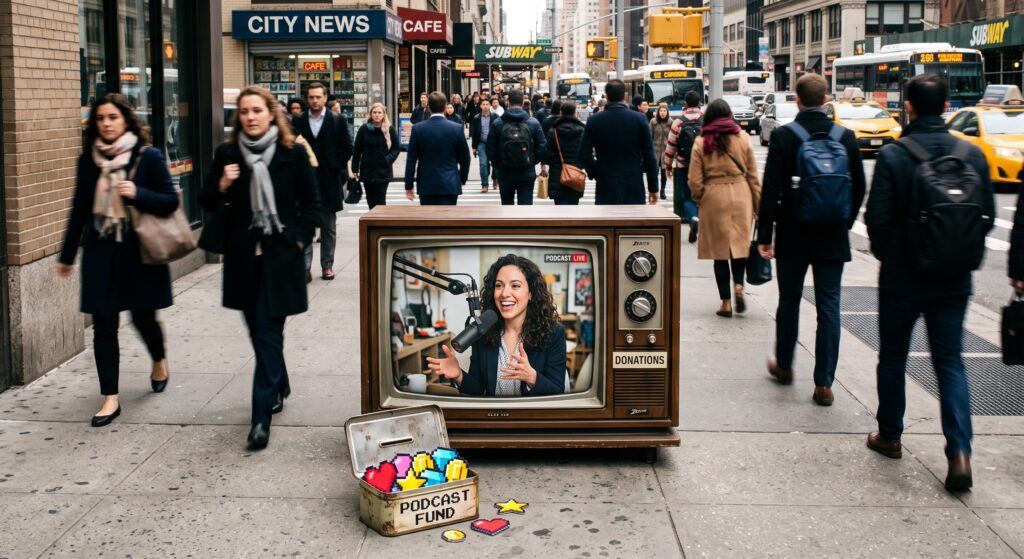
Imagine turning on your television tonight to find a network running 24 hours of programming. The broadcast features talk shows, investigative reporting, comedy sketches, cooking demonstrations, and cultural commentary. Commercial breaks air every few minutes, netting the network billions in corporate ad dollars.
Now imagine learning that the network didn’t hire a single writer, didn’t employ an actor, and didn’t spend a penny on production. Everyday people built the sets, filmed the scenes, and supplied the entire broadcast schedule out of their own pockets. And when those creators ask for their fair share of the commercial revenue, the network executive shrugs, hands them a cardboard cup, and says, “If you want to make money, ask the people watching on the couch to tip you.”
That is not dystopian fiction. That is the exact economic engine of modern social media.
Welcome to the free labor economy.
The Illusion of “Free” Entertainment
Platforms love to claim they are mere “neutral utilities” connecting people for casual entertainment. They point out that millions of users post casually without any expectation of a paycheck, sharing a family photo or uploading a quick clip. Tech giants use that casual baseline as convenient cover to avoid fairly compensating everyone.
The reality is that platforms cannot survive on casual photo-sharing anymore. They are engaged in an all-out war for human attention, competing directly with cable networks, streaming services, and movie studios. What keeps users hooked for hours isn’t corporate press releases, it is the dedicated, high-effort work of everyday producers, artists, commentators, and educators.
Big Tech relies entirely on this uncompensated workforce to generate the “dwell time” that makes their advertising inventory valuable. You supply the programming, they sell the commercial breaks. Yet the artificial thresholds required to see a single cent of direct compensation are rigged so high that the vast majority of contributors never see a dime.
The 1% Illusion: Survivorship Bias as Corporate PR
Whenever anyone critiques this rigged labor model, the immediate defense surfaces, “What about the creators making seven figures? Anyone can do it if they hustle.”
This defense relies on a textbook corporate trick, survivorship bias.
Tech executives love parading the top 0.1% on keynote stages and corporate blogs. They spotlight a handful of millionaire influencers landing massive brand deals and tell the public that the system is an open meritocracy. But pointing to a few lottery winners doesn’t prove an economy is healthy, it proves the house always wins.
The algorithm does not distribute attention based on merit. It concentrates traffic around established winners to guarantee predictable viewer retention for corporate sponsors. For the millions of everyday creators putting in 40 hours a week researching, scripting, and editing, the platform offers no viable middle class. It demands 100% of your labor while reserving 99% of the distribution for institutional names and legacy brands.
Even the Giants Aren’t Safe: The Broken “Subscribe” Button
If you think this trap only affects beginners and small accounts, look closer at the creators who were on top of the world just a few years ago. Channels that once commanded 5 or 10 million views per upload suddenly find themselves pulling 25,000. While 25,000 views is a respectable crowd, for a production built on viral scale, it represents a 99% collapse overnight. Novelty fades, and audiences naturally move on, that has always been the nature of entertainment. But on modern algorithmic platforms, that natural shift is met with a corporate guillotine.
The most egregious betrayal is what happened to the Subscribe and Follow buttons.
When you click “Subscribe,” you are giving explicit consent, I want to see this person’s work. But platforms quietly demoted the subscription tab and replaced it with a machine-driven recommendation feed. If a user doesn’t interact with a creator for a couple of weeks, the algorithm assumes they lost interest and scrubs that creator from their feed entirely. Viewers are now forced to manually search for creators they already follow just to see if they’re still active.
The platform actively puts up a wall between creator and fan so it can insert higher-paying commercial inventory and clickbait in between. Leaving all your financial eggs in a single algorithmic basket has ruined full-time creators who signed terms of service without realizing how total platform control really is.
The Threshold Wall: Gatekeeping the Little Guy
The unfairness goes even deeper than view counts, it is baked into the very ability to communicate. Consider live streaming. Many creators don’t jump on live feeds to make a fortune, they go live to build community, review shows, or debate current events in real time. Yet platforms turn basic communication into an obstacle course.
On TikTok, you are barred from going live from your phone until you clear an arbitrary 1,000-follower barrier. On YouTube, mobile streaming demands 50 subscribers and phone verification gates. Meanwhile, on platforms like Twitch, invasive corporate mid-rolls roll directly over live feeds meaning viewers permanently miss the punchline or the debate because a commercial took over the screen.
These arbitrary thresholds keep the little guy chasing moving goalposts. The platforms extract your viewership, your data, and your early watch hours for free, while dangling basic broadcast features behind endless algorithmic hurdles.
From Revenue Partners to Digital Panhandlers
In the early days of web video, platforms maintained at least the veneer of a business partnership, you brought the audience, the platform sold the ads, and both parties split the revenue down the middle.
Over the past few years, platforms quietly killed that model. They gutted creator funds, squeezed baseline ad shares, and replaced predictable compensation with virtual tip jars, badges, gifts, super-chats, and tip buttons.
By replacing legitimate ad-revenue splits with digital panhandling mechanisms, tech companies achieved two cynical goals:
- Zero Financial Risk: The platform extracts a 30% to 50% cut of every virtual sticker and tip while investing zero capital into producing the media.
- Moral Deflection: When full-time creators cannot pay their bills, the company points the finger at the audience, “Your community just isn’t supporting you enough.”
Content creation has been deliberately degraded from independent media production into real-time digital panhandling. Independent creators are forced onto marathon livestreams to perform distress and humble themselves before an audience that is already paying for internet access, device hardware, and sitting through unskippable ads.
Voting With Your Feet: Platforms Built on Fairer Foundations
Waiting on government regulators or corporate goodwill to fix the system is a dead end. Change only happens when creators and audiences collectively diversify their attention and stop treating rented land like a permanent home.
While many creators attempt to hedge by building Discord communities, a chat room alone isn’t a sustainable business model.
To survive, creators must transition toward platforms built with transparent revenue, direct distribution, and real data ownership:
- Ghost (Open-Source Independence): A modern publishing platform engineered for independent writers and media creators. Unlike social media, Ghost takes 0% of your earnings you connect your own payment processor and keep everything. More importantly, you own your website and your member email database completely.
- Substack (Direct Publishing & Newsletters): Eliminates algorithmic middle-men by delivering articles directly to subscriber inboxes and the reader app. It requires zero follower minimums to monetize, taking a flat 10% fee only when you make money, while letting you export your audience at any time.
- Patreon & Memberful (Direct Community Support): Replaces the undignified scramble for virtual tips with structured, predictable monthly memberships. Audiences pay for real value bonus commentary, behind-the-scenes access, or ad-free feeds while creators secure stable, recurring monthly income.
- Bluesky & The AT Protocol (Decentralized Social): An open social network that breaks the corporate monopoly on attention. Users choose their own custom algorithms rather than being force-fed corporate feeds, and external links to independent websites are not penalized or suppressed.
- Nebula (Creator-Owned Streaming): A curated streaming platform co-owned by the creators themselves. Nebula operates without invasive ad breaks, splitting 50% of all subscription revenue directly with video producers based on watch time.
Breaking the Cycle
Big Tech built multi-trillion-dollar valuations by convincing the everyday person that their time, creativity, and labor have zero monetary value. They engineered a system where viewers get gouged by rising subscriptions and ads, creators work for free, and platform executives pocket the difference.
The only way out of the trap is to recognize the game for what it is:
- Stop Giving Away the Store on Rented Land: Algorithmic platforms should be treated as top-of-funnel billboards, not permanent creative homes. If an app refuses to share the ad dollars you generate, direct your viewers off that sidewalk and onto your own platform.
- Build Direct Infrastructure: An independent website, an email list, and a direct RSS feed carry no algorithmic middlemen. A reader visiting your own site cannot be silenced or demonetized by an overnight algorithm tweak.
- Demand Real Value, Not Spare Change: If your audience supports you, it should be through direct, dignified subscriptions for high-quality commentary and reporting not loose digital coins tossed into a platform-controlled cup.
You are the programming. You are the talent. Stop busking on Big Tech’s sidewalk and build your own stage.
What’s Your Take?
Have you felt the algorithmic squeeze firsthand as a creator, or noticed your favorite channels disappearing from your feeds as a viewer? Are platform thresholds locking out the little guy, or is there still hope on rented land?
Sound off in the comments below, we want to hear your experience.