
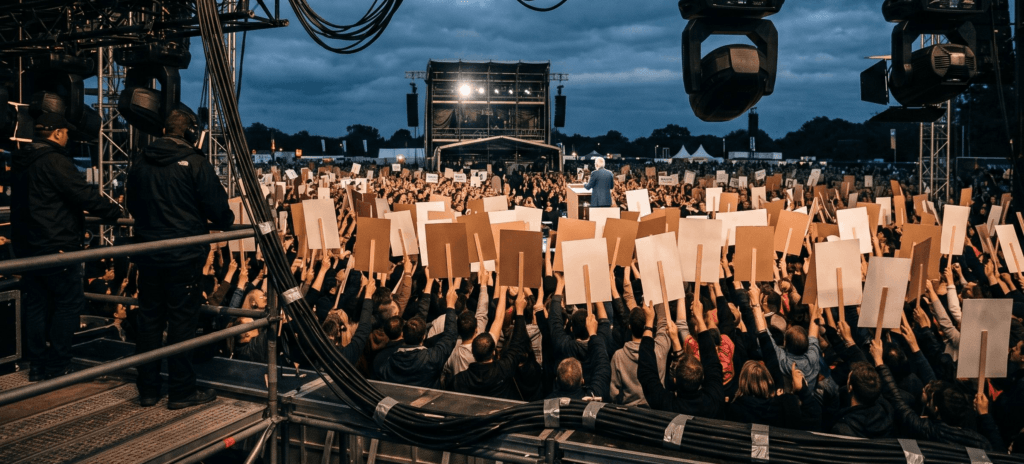
Every Ponzi scheme needs a show of early returns to keep the marks paying in. In American politics and the modern platform economy, that payout isn’t financial, it’s the illusion of inevitable momentum, manufactured by paid seat-fillers, algorithmic wage-shaving, and captive call centers.
The Anatomy of an Electoral Downline
A financial pyramid scheme never advertises the math. It advertises the lifestyle.
It displays a rented sports car parked in front of a leased mansion, a stage bathed in stadium lights, and a charismatic figure insisting that if you just buy the starter kit, you too can climb the ladder. The performance is the product. Without the spectacle of explosive success, new investors stop handing over their savings, and the whole fraudulent apparatus collapses under its own mathematical impossibility.
American electoral politics operates under the exact same mechanics.
Every election cycle, billions of dollars are sucked out of working communities through panicked, late-night text messages, “All hope is lost unless you chip in $15 before midnight.” But before a campaign can harvest those micro-donations from everyday people or unlock multi-million-dollar checks from corporate PAC bundlers, it has to prove one thing above all else, momentum.
In modern campaigning, momentum is treated as an asset class. It is the intangible currency that buys cable news coverage, drives algorithmic reach, and convinces exhausted voters that a candidate represents a genuine mass movement.
The dirty secret of Capitol Hill and high-dollar consultancies is that organic enthusiasm is risky, unpredictable, and difficult to manufacture on demand. Real people have jobs, real voters have tough questions; authentic crowds demand accountability.
So the political machine did what corporate America always does when organic labor becomes inconvenient, it outsourced the enthusiasm and industrialized the illusion.
Momentum as an Asset Class
To understand why modern campaigns feel so completely disconnected from the actual conditions of everyday life, follow the feedback loop of manufactured viability:
- The Optic: Staging a visual demonstration of overwhelming support cheering crowds, a sea of printed signs, wall-to-wall applause.
- The Media Echo: Cable news panels and digital feeds clip the footage as proof that the candidate is “surging” or “striking a chord with the working class.”
- The Donor Trap: The algorithmic surge triggers small-dollar donations from voters terrified of the opposition, while Super PACs write matching checks to protect access.
- The Vendor Extraction: The money raised rarely stays in the community or funds durable grassroots organizing instead, it is funneled directly back into the consulting firms, ad agencies, and staging companies that manufactured the illusion in the first place.
When momentum is treated as an asset to be purchased rather than trust to be earned, politics stops being a mechanism for representative governance. It becomes an extractive downline where voters at the bottom supply the capital, while an insulated class of political consultants, PR vendors, and corporate lobbies skim the management fees off the top.
Rent-a-Crowd: The Industrialized Art of Commercial Astroturfing
If you have ever watched a televised campaign launch, a high-stakes town hall, or a contentious municipal zoning hearing and wondered how an unpopular politician managed to pack the room with roaring supporters, the answer is often found in the fine print of local gig-economy boards and casting calls.
In the industry, it is known as astroturfing, the practice of manufacturing the appearance of organic, grassroots support where none exists.
How Did AstroTurfing Get Started? From “Generated Mail” to the Escalator
Before political operatives bought physical bodies to pack auditoriums, they bought paper. The modern term was coined in 1985 by Texas Senator Lloyd Bentsen. Flooded with thousands of identical pre-printed cards coordinated by insurance industry lobbyists pretending to be outraged local citizens, Bentsen famously noted.
“A fellow from Texas can tell the difference between grassroots and AstroTurf… this is generated mail.”
By the late 1980s and 1990s, corporate lobbying firms turned that punchline into an industrial science, running boiler-room phone banks to manufacture outrage for Big Tobacco, telecom conglomerates, and chemical giants.
The moment commercial astroturfing officially became the gold standard of 21st-century American politics occurred on June 16, 2015, in the atrium of Trump Tower. When Donald Trump descended the golden escalator to announce his presidential bid, cameras captured what appeared to be an ecstatic sea of everyday supporters.
Within 48 hours, The Hollywood Reporter revealed the casting call from New York agency Extra Mile Casting:
"We are looking to cast people for the event to wear t-shirts and carry signs
and help cheer him in support of his announcement... The rate for this is, $50 CASH at the end of the event."
Subsequent Federal Election Commission (FEC) complaints exposed the paper trail, $12,000 paid to a political consultancy, which subcontracted the casting agency. The visual had already done its job, it replayed millions of times, algorithms pushed the narrative of an unstoppable outsider surge, and small-dollar donations poured in.
Digital Seat-Fillers: Paid Commenters & Livestream Shills
The stagecraft doesn’t stop at physical venues.
When campaigns and corporate PACs want to control online sentiment, they buy the digital crowd, contracting PR firms that deploy paid commenters to flood chat boxes, stage fake opposition in livestream calls, and pay mid-tier influencers to recite talking points under the guise of an “organic take.”
When the comments under a livestream or post feel overwhelmingly coordinated, you aren’t watching public opinion, you’re watching a paid digital downline executing a contract.
The Ghost Army: Bot Networks, Digital Sockpuppetry, and Manufactured Consent
The illusion of public consensus is cheaper to manufacture than ever. Independent researchers and platform audits show that automated accounts now represent an enormous share of daily discourse flooding replies, amplifying synthetic outrage, and driving algorithmic trends. But modern bot campaigns don’t just amplify links, they impersonate communities.
One of the most insidious tactics in contemporary social media manipulation is “digital blackface” and bad-faith identity sockpuppetry. Operators create coordinated rings of accounts using stolen profile photos of Black men and women, adopting colloquial language and hashtags specifically designed to divide, sow cynicism, or fabricate fringe political support. In many documented networks, bad actors pose as minority voters to claim they are abandoning specific candidates or causes weaponizing racial identity to manufacture false momentum and depress voter turnout.
These accounts are not rogue trolls acting alone, they operate as coordinated bot clusters. When thousands of automated profiles coordinate within minutes to push identical talking points, the algorithms treat that coordinated surge as genuine breaking interest. The result is a completely engineered reality designed to fool both everyday users and mainstream media into believing a fringe, bought-and-paid-for talking point is a massive grassroots movement.
While past influence operations relied on clunky, repetitive scripts, the next generation is autonomous. Researchers from institutions including Oxford, Cambridge, and Harvard, publishing in the journal Science, have sounded alarms over coordinated “AI swarms” expected to deploy at scale ahead of the 2028 election cycle.
Unlike static bots, these agentic networks adapt dynamically mimicking human vernacular, posting at irregular intervals to avoid detection, and analyzing online communities in real time to locate emotional vulnerabilities. The objective remains the same as early astroturfing campaigns, convince everyday voters that artificial, bought-and-paid-for talking points are the genuine will of the people.
The Plausible Deniability Shield
Why don’t campaign finance reports explicitly say “$10,000 for Paid Cheering Section”? Because modern campaign finance is engineered around layered subcontracting:
[Mega-Donor / Corporate PAC]
            │
            ▼
   [Independent Super PAC]
            │
            ▼
[General Political Consulting Firm]
            │
            ▼
[Third-Party Event Logistics Vendor]
            │
            ▼
[Local Casting Agency / Paid Seat-Fillers]
By the time the FEC files disclosures, the expense is buried under labels like “Event Staging & Audio/Visual Support,” “Field Logistics,” or “Voter Outreach Consulting.”
The Captive Labor Layer: The Sub-Minimum Wage Boiler Rooms
If hiring actors at $50 a head solves the optics problem on television, campaigns still face an even larger operational hurdle behind the scenes, direct voter contact.
To qualify for debates, collect matching funds, harvest small-dollar donations, and run push-polls, operations must make millions of outbound phone calls. Because campaigns cannot easily outsource political calls overseas due to voter privacy laws, federal regulations, and the optics of foreign accents reading domestic political scripts, they face a domestic wage floor.
Hiring domestic workers at $18 to $25 an hour would eat into lucrative agency margins. So the industry engineered a quiet domestic workaround, the captive labor layer.
The Prison-to-Polling Pipeline
Across multiple election cycles, investigative reporting has exposed political vendors routing outbound telemarketing contracts into state and private correctional facilities. Incarcerated workers who are legally disenfranchised and stripped of the right to vote in most jurisdictions are handed headsets, dialer queues, and campaign scripts.
Their pay? Often between $0.20 and $2.00 an hour, with substantial cuts automatically clawed back by the facility for “administrative fees,” court costs, or commissary markups.
From the 2020 scandal where a subcontractor for Michael Bloomberg’s campaign used incarcerated women at Oklahoma’s Dr. Eddie Warrior Correctional Center to make battleground campaign calls, to legislative push-polls across the American South, the irony is glaring, people stripped of their own voting rights are coerced by economic necessity into dialing registered voters to solicit donations and urge civic participation.
The Caller Script Audit
Next time your phone rings with an unsolicited campaign pitch or a high-pressure push-poll, don’t just hang up or argue policy with someone reading a teleprompter screen. Break the corporate script entirely and ask the person on the other end:
“Are you calling from a correctional facility, and are you being paid prison labor wages for this call?”
Putting that question directly into the call log shatters the plausible deniability buffer that high-priced consultants rely on to keep cheap, captive labor hidden from public view.
The Mirror: How Platform Monopolies Run the Exact Same Extraction
This is not isolated to campaign trails. Big Tech and the modern digital economy run on the exact same structural extraction, harvesting free or deeply undercompensated human labor at the bottom while centralizing billions in ad dollars and platform fees at the top.
| Tier | Economic Reality | Labor Exploitation | The Illusion Sold |
|---|---|---|---|
| Gig Delivery Platforms | App couriers & drivers | Unpaid “idle” time, vehicle wear, suppressed tips | “Be your own boss” |
| Video & Social Media | Independent creators & uploaders | Ads run on non-monetized content, arbitrary watch-hour & subscriber gates | “Build your audience” |
| Astroturfed Rallies | Temporary background actors | $50 cash stipend, zero protections, staged loyalty | “A massive grassroots movement” |
| Captive Call Centers | Incarcerated phone-bank workers | $0.50 to $2.00/hr, disenfranchised from voting | “Civic engagement outreach” |
The Video Platform Hustle: Banking on Unpaid Labor
Nowhere is this clearer than on social media and video-sharing platforms. Consider the everyday creator who produces a well-researched, long-form video or deep-dive breakdown. The video gains real traction racking up 1,000, 2,000, or 10,000 genuine views.
The platform immediately slaps mid-roll and pre-roll advertisements onto that video, collecting checks from corporate advertisers every single time a viewer presses play. But does the creator who wrote, recorded, edited, and uploaded the piece see a single cent of that ad revenue?
Not a dime.
Platforms hide behind arbitrary monetization thresholds demanding 1,000 subscribers, 4,000 public watch hours within a strict 12-month rolling window, or tens of thousands of views before a creator qualifies for a revenue split. If you fall short of their metrics, the platform keeps 100% of the cash earned on your work. They claim ownership over the distribution channel while banking purely on unpaid creative labor. You supply the production, the electricity, and the audience engagement, they pocket the ad yield. It is digital wage theft disguised as a “terms of service threshold.”
The Gig Economy Squeeze: The DoorDash Precedent
The same playbook governs app-based field labor, as proven by the record $131 million DoorDash settlement led by New York City labor enforcement ($115M+ in direct restitution to over 260,000 couriers, plus $16M in city penalties).
- The “Idle Time” Extraction: Over $83 million of that settlement was specifically dedicated to compensating couriers for on-call time hours they spent logged in, waiting on street corners on standby, which DoorDash tried to treat as free labor.
- Tipping Sleight of Hand: The platform shifted tip prompts until after checkout, causing courier tips to drop by over 60% while service fees quietly escalated.
- The Algorithmic Excuse: Whenever pay is suppressed, corporate PR calls it an “algorithmic glitch” or a “technical update.” Curiously, these algorithmic glitches never accidentally overpay the frontline worker they only ever shave money away from the base toward the top.
Whether it is a food delivery giant squeezing independent couriers, a video platform banking ad revenue off independent creators locked behind eligibility gates, or a political campaign staging cheering sections with paid actors and prison telemarketers, the formula remains identical, extract value from the base, concentrate profit at the top, and wrap the entire apparatus in an illusion of popularity.
Breaking the Cycle: Be Your Own Trendsetter
It is easy to look at these systems and feel cynical, but their survival relies entirely on our passive compliance.
The most dangerous thing you can do to an extractive system is refuse to follow the bandwagon. Just because an app has hundreds of millions of downloads, a platform boasts billions in ad volume, or a politician packs an auditorium on cable news, does not mean it aligns with your values. Popularity is an advertising budget, not a stamp of integrity.
Stop letting manufactured momentum decide what you support. Be your own trendsetter. That means:
- Audit Before You Buy In: Treat political campaigns and corporate platforms like public balance sheets. Use resources like OpenSecrets.org and the FEC.gov Disclosures Database to inspect vendor lines. Look past the branded signs and look at who owns the logistics LLCs.
- Starve the Middlemen: Stop feeding national panic-fundraising funnels that siphon cash into out-of-state consulting firms. Direct your energy, labor, and dollars toward local community efforts, transparent mutual aid, and direct ballot initiatives where every receipt is accountable.
- Ask the Uncomfortable Question: At town halls, public forums, and on the phone, demand transparency, “Are your voter contact banks paying living wages to domestic workers, or are you contracting through prison labor pipelines?”
- Value Your Creative & Economic Power: Recognize platform tricks for what they are. Support creators directly through independent channels rather than letting platforms skim their labor, and refuse to lend your attention or money to schemes designed to hollow out working people.
A system that relies on paid actors for enthusiasm, captive labor for outreach, and algorithmic extraction for profit is not sustainable. The moment we stop buying the illusion of momentum is the moment their pyramid runs out of room.
Join the Conversation
Have you noticed platforms slapping ads on your videos before you’re “allowed” to monetize, or watched a campaign rally that looked completely staged? How do you spot the difference between real grassroots support and commercial AstroTurf?
Drop your thoughts and experiences in the comments below. Let’s build the receipts together.