
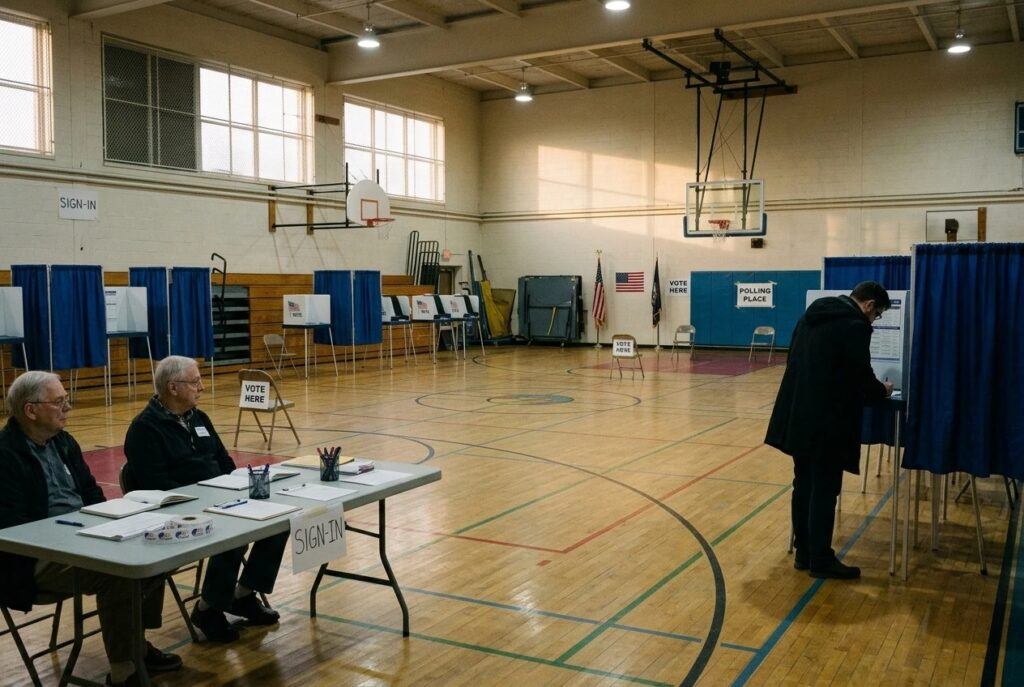
When voter turnout is low, the people who do vote decide the outcome for everyone else. Primary voters pick the likely winner in safe seats, small electorates fill school boards and city councils, and campaigns plan around the voters they know will show up.
Staying home does not pause those decisions. It hands them to a smaller group.
Who decides an election when most people stay home?
The voters who cast ballots decide it, and that group is almost always older, more settled and more politically engaged than the population as a whole. An election is decided by the ballots counted, not by the number of people eligible. A race with 20 percent turnout is settled by roughly a fifth of the electorate, and the result is just as binding on the other four-fifths.
This is why low turnout rarely looks like a failure of the system. Nothing flags it. The winner takes office, passes budgets, appoints staff and signs contracts with full legal authority.
What did the 2026 midterms show about what showing up changes?
They are the most recent example of the same thing: a midterm decides who controls the committees and chambers that write laws and oversee the executive branch.
The midterms ended this week, and counting and certification are still under way in many places, so this article does not quote seat totals that could shift.
Take the final numbers from official sources: your state’s secretary of state or election division, the Clerk of the House, the Secretary of the Senate, and a wire service such as the Associated Press.
Once you have the final numbers, three things are worth checking in the races that mattered most:
- The margin of victory. Compare it with the number of registered voters in that district or state who did not vote. In a close race, the non-voters outnumber the margin many times over.
- Which seats changed hands. A seat that flips changes who chairs committees, who schedules hearings, and who can issue subpoenas.
- Senate outcomes. The Senate confirms judges and cabinet-level officials, so a change in a single seat can change who gets confirmed.
Chamber control sets the agenda: which bills get a floor vote and which never leave committee. That effect begins with ballots cast in November, and it reaches back into the primaries that chose the nominees.
What did the results show about representation when diverse coalitions show up?
Turnout does not just decide party control, it determines whose lived experience informs legislation, committee agendas, and public policy.
When historically underrepresented communities organize and cast ballots, they reshape the demographic and cultural makeup of government.
The 2026 cycle demonstrated how concentrated participation translates into barrier-breaking representation across federal and state levels.
Milestones for Women:
- First Native American Woman in the U.S. Senate: Peggy Flanagan of Minnesota won her contest, becoming the first Native American woman elected to the U.S. Senate.
- First Native American Woman Governor: Deb Haaland made history in New Mexico as the nation’s first Native American woman elected governor.
- First Black Woman Governor: Keisha Lance Bottoms won the Georgia gubernatorial race, becoming the first Black woman elected governor in American history.
- State Executive Firsts: Gina Hinojosa became the first Latina governor of Texas, Amy Klobuchar became Minnesota’s first woman governor, and Annie Andrews became the first woman elected to the U.S. Senate from South Carolina.
- Congressional Representation: Democratic women surpassed 100 seats in the U.S. House of Representatives, with women candidates flipping 18 of the critical House battleground seats.
Milestones for Muslim Americans:
- First Muslim U.S. Senator: Abdul El-Sayed won Michigan’s Senate contest, becoming the first Muslim elected to the United States Senate.
- New State Delegations: Adam Hamawy won New Jersey’s 12th Congressional District, becoming the state’s first Muslim member of Congress as part of a record number of Muslim lawmakers elected to federal office.
Milestones for Gay, Transgender, and Nonbinary Leaders:
- First Openly Gay U.S. Senator: Chris Pappas won in New Hampshire, becoming the first openly gay man elected to the U.S. Senate.
- Historic House Firsts: JD Ford unseated a GOP incumbent in Indiana to become the state’s first openly gay member of Congress, while Michigan elected Jeremy Moss as the state’s first openly gay representative.
- State Legislative Breakthroughs for Transgender Representation: Allison Montgomery won her race to become Alabama’s first openly transgender state lawmaker, and Bentley Hudgins won an Assembly seat in Georgia as the state’s first openly trans and nonbinary state lawmaker.
None of these milestones occurred by default. They were built on primary turnout in the spring and summer that secured ballot slots, followed by coalition-building in November.
When communities sit out, the candidates who advance inevitably reflect a narrower, less diverse segment of the population.
Why do primaries and safe seats matter more than the November headline?
In a safe seat, the primary is often the real election, because one party’s nominee is very likely to win in November. Gerrymandered or lopsided districts make this common, and whoever wins the primary effectively wins the office for that term.
Primary turnout is usually far lower than general election turnout. In many states, closed primaries limit participation to registered members of a party, so a voter who is unaffiliated or unregistered by the deadline cannot take part at all. Other states hold open primaries, and a few use a single top-candidate format. The rules differ by state, so look up yours.
This affects what the November ballot offers. By the time most people vote, the field has been narrowed by a small share of the electorate, and the general election choice reflects the preferences of the people who showed up in spring or summer.
Primary dates also come early. Some fall in the first half of the year, with filing deadlines and registration cutoffs well before that. If you only start paying attention in the fall, the choice that mattered most is already made.
What gets decided in off-cycle and local elections that you never hear about?
Property taxes, school curriculum, zoning, policing policy and local contracts are decided in elections that rarely make national news. Many cities, towns and school districts hold their elections in odd-numbered years or in the spring, specifically apart from the November federal cycle. Turnout in these elections is often a small fraction of presidential-year turnout, so a few hundred or a few thousand votes can decide a seat.
Here is what sits on those ballots and in those rooms:
- School boards set budgets, approve curriculum materials, hire and evaluate the superintendent and decide on school closures.
- City and county councils vote on zoning, development permits, local taxes, public safety budgets and franchise agreements.
- Special districts such as water, fire, transit and library districts levy their own taxes, often with very little public attention.
- Judges, sheriffs, prosecutors and clerks, depending on your state, are elected in local or down-ballot races.
- Ballot measures put bond issues, tax changes and sometimes state constitutional amendments directly to voters, and a measure passes or fails by the votes cast, not by how many people knew it was on the ballot.
Then there are appointments. Elected officials fill planning commissions, housing authorities, zoning appeal boards and many other bodies. The people who appoint those members are chosen by whoever votes, so turnout shapes these bodies indirectly, and those bodies make decisions with real money attached. For a practical method of following those decisions between elections, see How to Audit Your Local Government Without a Law Degree or a Press Badge.
How do campaigns and interest groups plan around people who don’t vote?
They concentrate their effort on the people who reliably vote, because every dollar and every volunteer hour is limited. Campaigns build their contact lists from voter files, which record whether a registered voter cast a ballot in past elections (not whom they voted for). Someone with a history of voting in every election gets mailers, calls and door knocks. Someone who votes only in presidential years gets less. Someone who has never voted may get nothing at all.
The result is a feedback loop that follows directly from how outreach is budgeted. Candidates talk about the issues that matter to the people they expect to hear them, policy follows those priorities, and people outside the audience feel ignored and are less likely to vote next time.
Interest groups work the same way, with an added advantage in low-turnout races. A group that can deliver a few hundred reliable voters to a school board election or a ballot measure can swing the result. Organized groups know this, and it is one reason local races attract concentrated spending relative to the number of votes involved. If you want to see who is funding the push behind a specific bill at the federal level, The Lobbyist’s Ledger walks through how to trace it.
What is the next election on your calendar after the midterms?
It depends on where you live, and the answer is often closer than you expect. After a federal midterm, the next elections on your calendar may include:
- A runoff or special election, in states that use them, shortly after the general election.
- Municipal, school board or county elections in 2027, in places that hold them in odd-numbered years.
- Spring local elections, which some cities and counties hold separately from the November cycle.
- State and federal primaries in 2028, which can have registration deadlines and party-affiliation rules well ahead of the vote.
- Ballot measures, which can appear on any of the above.
Do not guess. Your county or state election office publishes an official election calendar, and most will list every contest, deadline and polling place for your address. Write the next three dates down, including the registration deadline for each, since that deadline usually comes weeks before election day.
How can you check your registration and start tracking local decisions now?
Start with your registration, because a moved address, a name change or a missed update can leave you unable to vote in the election you care about. Use only your state’s official election site or a vetted route to check it. Third-party lookup sites can collect your personal information, and our guide explains how to avoid them: How To Check Voter Registration Safely (And Avoid Third-Party Traps).
After that, build a short routine for tracking decisions between elections:
- Find the meeting schedule for your city or county council and your school board, and look at the agenda posted before each meeting.
- Note which seats on those bodies are up for election next and when.
- Read the sample ballot for your address as soon as your election office publishes it, so ballot measures and down-ballot offices are not a surprise.
- Look up who appoints the members of the boards that affect you most, such as zoning, housing or transit.
- Pick one local issue and follow it through the agenda to the vote.
Turnout is not the only thing that shapes these outcomes, but it is the part any eligible voter can change by acting.
Check your registration through the safe method in our voter registration resource guide, then browse the Resources page to find tools for tracking your local officials between elections. Then leave a comment below and tell us which local election on your calendar you will show up for next.