
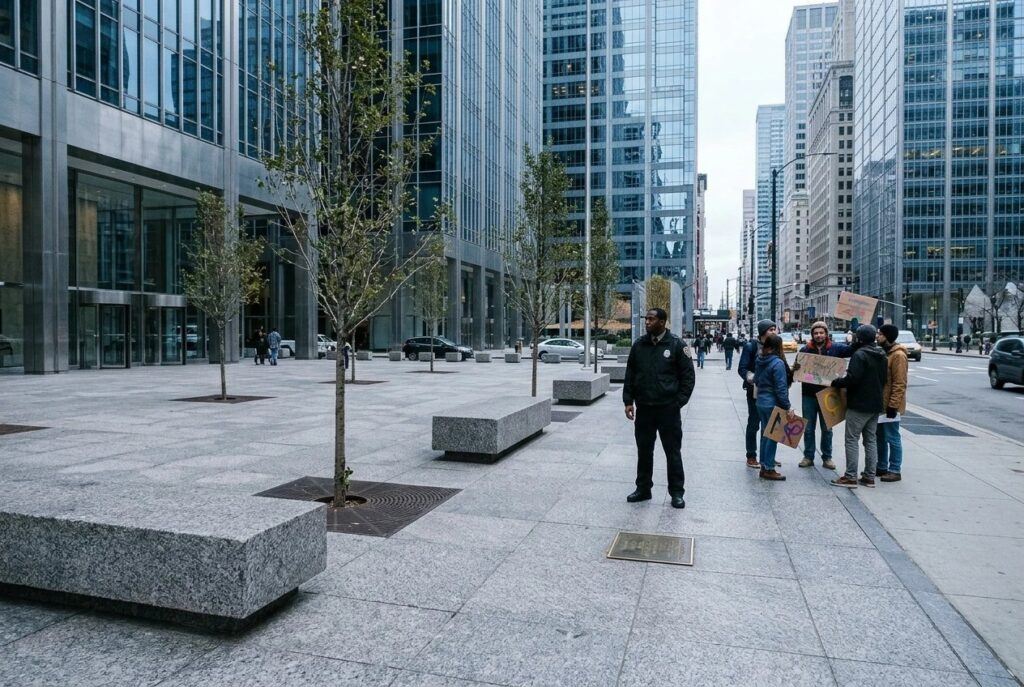
Can you legally protest on private property? In most of the United States, the answer is no, at least not as a matter of constitutional right. The owner can tell you to leave, and if you stay, the police can arrest you for trespass. That answer surprises many people who attend demonstrations, because they assume the First Amendment travels with them wherever they stand.
It does not. Every time a square, a plaza, a campus quad or a communication channel passes into private hands, the constitutional protection for dissent vanishes with the change in ownership. This article lays out the legal rule, the cases that set it, the places where it gets blurry, and a short check you can run before you gather. It is general information, not legal advice, and the rules differ by state and city.
The Rule Most Protesters Never Learn: The First Amendment Stops at the Property Line
The First Amendment says “Congress shall make no law” abridging speech, and the Supreme Court has long read that to cover government at every level. It restricts what a city, a state or a police department can do. It does not restrict what a store owner, a landlord or a private university can do.
That is the state action doctrine. If the entity telling you to stop is private, you have no First Amendment claim against it, in the same way you cannot sue a restaurant for violating your right to a jury trial. The owner’s rights over their property, including the right to exclude, usually win.
What the protection does cover is the traditional public forum, streets, sidewalks and parks held open to the public, where the government can only impose reasonable limits on time, place and manner. The practical question for any protester is therefore less “what are my rights?” than “who owns this ground?”
From Company Towns to Shopping Malls: How the Courts Drew the Line
The first crack in the rule came in Marsh v. Alabama (1946). A shipbuilding company owned the entire town of Chickasaw, Alabama, including its streets and sidewalks. A Jehovah’s Witness was arrested for distributing religious literature there. The Court held that because the company ran what was functionally a town, it could not use trespass law to shut out speech that a municipal government could not suppress.
For a while, the logic spread. In Amalgamated Food Employees Union v. Logan Valley Plaza (1968), the Court applied it to a shopping center, reasoning that the mall had taken over the role of the business district.
The Court then reversed course. Lloyd Corp. v. Tanner (1972) narrowed the earlier ruling, and Hudgens v. NLRB (1976) settled the matter for the federal Constitution: union pickets at a privately owned shopping center had no First Amendment right to be there. Marsh survives, but only for property that truly performs the full functions of a municipality.
States kept a door open. In PruneYard Shopping Center v. Robins (1980), the Court held that a state may protect speech on private property more broadly than the federal Constitution does. California’s constitution does so, and courts in a handful of other states, New Jersey among them, have recognized some speech rights at large private venues. Most states have not. So the same leaflet at the same mall can be protected in one state and a trespass in the next.
The Plaza That Looks Public and Isn’t: Privately Owned Public Space and Business Improvement Districts
Many places look and feel public while sitting on private title. Two arrangements matter most.
Privately owned public spaces. Since 1961, New York City’s zoning rules have let developers build taller in exchange for providing plazas or arcades open to the public. Zuccotti Park, where Occupy Wall Street camped in 2011, is one of these. The owner was a private company, and it asserted the right to set rules for the space. The public had access, but the owner controlled the terms. Other cities have similar bonus programs.
Business improvement districts. A BID is a defined area where property owners pay an extra assessment that funds services such as cleaning, marketing and private security. Many are run by nonprofit boards rather than city agencies. Their guards may enforce rules on sidewalks and plazas that the district manages, and whether the First Amendment reaches those rules depends on how closely the BID is tied to the government that authorized it. Courts have not answered that consistently.
The common thread is that access is granted by the owner or the district, not guaranteed by the Constitution. Posted rules about signs, amplified sound or “commercial activity” often cover demonstrations, and enforcement frequently comes from security staff rather than police.
One distinction saves a lot of confusion: a public sidewalk that runs past a private building is still public. The line between a city sidewalk and a mall’s own walkway is often a few feet, and it is the line between a protected gathering and a trespass.
Permits, Fees and Buffer Zones: How Public Ground Gets Quietly Rationed
Even on genuinely public ground, access can be narrowed without any one rule banning protest. Courts allow governments to regulate time, place and manner if the rules are content-neutral, serve a significant interest and leave other ways to communicate. Within those limits, cities have a lot of room.
- Permit requirements. Many cities require permits for marches or for gatherings above a certain size, and some require them weeks ahead, which rules out a response to breaking news.
- Fees and insurance. The Court held in Forsyth County v. Nationalist Movement (1992) that a fee cannot be set according to how hostile an audience might be, but cities can still charge administrative costs and require liability coverage, which a small group may be unable to afford.
- Buffer and exclusion zones. In McCullen v. Coakley (2014), the Court struck down a 35-foot buffer zone around abortion clinics in Massachusetts as too broad. The ruling shows that such zones can be challenged, but they remain common around government buildings, courthouses and events designated as special security areas.
- Event designations. A park or street that is open on Tuesday can be closed on Saturday because a permitted festival has reserved it, sometimes under a contract with a private promoter.
None of these is a ban, which is why they rarely draw attention. Together they decide who can gather quickly, cheaply and where the audience is.
The Digital Square Is Private Too: What Platform Ownership Does to Dissent
Much of today’s organizing and argument happens on platforms owned by companies. The Court has called social media the modern public square, in Packingham v. North Carolina (2017), but that case stopped the government from barring people from sites. It did not make the sites themselves accountable to the First Amendment.
In Manhattan Community Access Corp. v. Halleck (2019), the Court held that a private operator of public-access channels was not a state actor, and the reasoning applies broadly to private media companies. In Moody v. NetChoice (2024), the Court treated a platform’s decisions about what to display as the platform’s own expressive choices, which strengthens the owner’s position further.
In practice, an account can be suspended, a post demoted or a group removed by a company under its own terms of service, with no required hearing and no obligation to explain. A reach reduction may be invisible to the person affected. For a deeper look at how feed design shapes what people see, see Nobody Can Audit the Feed That Shapes Your Vote.
Before You Gather: A Five-Question Check for Who Controls the Ground
Before you plan or join a demonstration, answer these five questions.
- Who holds title to this ground? County property records will show the owner of record. A corporation, a university or a trust points to private rules. A city, county or state agency points to public ones.
- Is it a street, sidewalk or park, or a walkway inside a development? Public rights-of-way are usually marked on city maps. Interior paths at a mall or office complex usually are not public.
- Does a plaza carry public-access conditions? For a privately owned public space, find the approval documents or the city’s list of such spaces. They may state the hours and what the owner may restrict.
- Which state am I in? Some state constitutions give broader speech rights on private property. Check the state’s case law, or ask a legal group.
- What does the city require? Look up the permit rules for the size and route of the gathering, along with fees, deadlines and any special event designation for that date.
If you are told to leave private property, the safest course is to comply and move to a nearby public location. Keep in mind that arrests and citations are far easier to fight when you know which side of the property line you were standing on. For legal help, the Pro Bono Know directory lists free civil rights resources.
What a Real Commons Would Require: Policy Fixes Worth Demanding
The rules above are products of law and zoning, so they can be changed by law and zoning. These are reasonable demands to put to local and state officials:
- State-level speech protections. A state constitution or statute can protect peaceful expression at large private venues that function as community gathering places, as California’s does.
- Enforceable terms for public-access spaces. When a city grants a developer extra building rights in exchange for a plaza, the agreement should state in plain language which activities are allowed, and the city should be required to inspect and enforce it.
- Transparency for business improvement districts. Boards should publish their rules, security policies and incident records, hold open meetings and face the same constitutional limits as the city that authorized them.
- Predictable permits. Fee waivers for small groups, short approval deadlines, and a fast exception for spontaneous responses to news events.
- Procedural rights on large platforms. Notice, a stated reason and an appeal when an account or group is removed, plus public reporting on removals.
Look Up the Ground Beneath the Last Gathering You Saw
Think of the last place in your town where you saw a demonstration or a public gathering. Look up the parcel in your county’s property records, usually through the assessor’s or recorder’s website, and see who actually owns it. Then compare that answer with what you assumed.
To see how this fits into a wider pattern, read the earlier piece, The Bomb Drop: Viral Racism, Big Tech Complicity, And The War On Public Spaces. Then leave a comment below with what you found, or with your own experience being moved along from a space you thought was open. For more tools and references, visit the Resources page.